Christian Reading, The Strand, and a Toast to the Inklings
by Erin Doom
Feast of the Holy Protection of the Theotokos
Anno Domini 2020, October 29
As you read through today’s issue of Microsynaxis, if you are encouraged, challenged, enlightened, or find any value whatsoever in this labor of love, please consider joining the community of Eighth Day Members at any level.
1. Bible & Fathers: “Christian Reading as a Means of Enlightenment” by Abbot Herman
Thursday – Feast of St Anastasia the Martyr of Rome: Col. 1:24-29; 2:1. Lk. 11:14-23. Online here.
Friday - Feast of Cleopas & Artemas of the 70 Apostles: Col. 2:1-7. Lk. 11:23-26. Online here.
Saturday - Feast of the Holy Martyr Epimachus of Egypt: Rom. 16:1-16. Lk. 8:16-21. Online here.
Sunday - Feast of SS. Cosmas & Damian the Holy Unmercenaries of Asia, and Their Mother Theodota: 1 Cor. 12:27-31; 13:1-8. Lk. 16:19-31. Online here.
Here are the opening lines to a great (and short) piece on the need for “Christian reading” in an age in which the “purpose of spirituality has become earth-oriented, pragmatic, egotistic, and thus insensitive to the eternal reality that surrounds man: nature, the universe, and God, Whose image has become dim in the sight of modern man.”
When it comes down to the very basics, it seems that the essential problem of present-day Christianity is the weakness of Orthodox witness and lack of adequate Enlightenment, i.e., religious education and evangelization with the knowledge that God has become incarnate in humanity and now for 2,000 years has manifested divinity in men—active, vibrant, and dazzling with Uncreated Light. And this is straight up to our century and even our time. The documentation of Acts and the distribution of writings among all nations has since Apostolic times resulted in the phenomenon of Christian literature. In the course of time and under various influences this has developed into diversified forms of modern literature, which nowadays, alas, is hostile to its very initiative and its holy calling. The “Gutenberg” printing press is working against its original purpose—to bring Christ’s Enlightenment to the fallen world.
2. Books & Culture: "Many Worlds: The Strand or Eighth Day Books?"
The owner of The Strand, a famous 93-year-old bookstore (also the largest one in NYC), recently tweeted out a plea for help from customers because their 2019-2020 year-to-year revenue is down 70%. Douglas Murray offers a unique perspective, pondering whether the demise of The Strand might not be such a bad thing. According to Murray,
The book trade in America is badly screwed up, as it is everywhere. In part this is because many publishing houses seem to think that their role is not to give the public the books they want, but rather the books the publishing houses think they would be best instructed by. It is the nature of the publishing industry, and the way it hires, that the viewpoint diversity in the sector is narrow, blinkered, and parochial.
That same viewpoint is now replicated on the frontline. Increasingly bookstores are places where customer are force-fed books that the store’s employees think will be good for them. In recent months in particular bookstores in the US have decided that if they push certain products on the public hard enough then all those who work there will be doing their bit to defeat white supremacy / embedded racism / patriarchy / cisheteronormativity / Donald Trump and more. The joy of bookshops used to be that they offered an opportunity for the reader to open their mind up to many worlds. Today many bookstores seem to think that their role is to force-feed their customers with only one view of the world: one that the retailers honestly seem to believe is the only worldview a literate or thinking person could possibly have.
The Strand has become among the worst offenders.
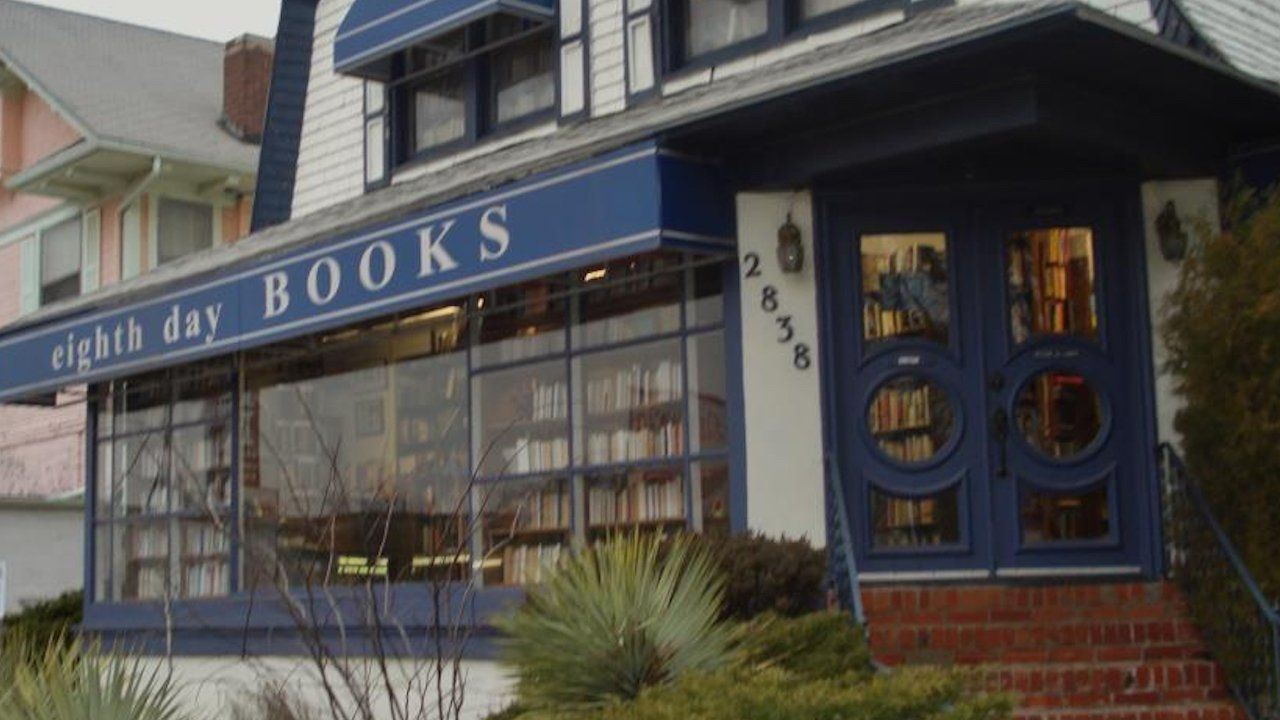
While both Eighth Day Books and Eighth Day Institute are definitely committed to peddling the early Christian Fathers and books that shed light on ultimate questions in an excellent way, we are also committed to offering opportunities for you to not only open your mind up to many worlds, but also to engage in authentic dialogues of love and truth. So instead of supporting The Strand, consider supporting the Eighth Day enterprise: get your books from Eighth Day Books AND join the community with an Eighth Day membership.
And you can read Murray’s whole piece on the Strand here.
3. Essays et al: “Myth Made Fact: A Toast to the Inklings as Spell Breakers” by Richard Rohlin
Last year at the 2019 Inklings Walking Tour, Richard Rohlin offered a toast at each of the three microbreweries we visited. The concluding toast reflected on the famous conversion of C. S. Lewis on Addison’s Walk which went into the wee hours of the night (4 am, to be precise). The next day, Lewis described the evening in a letter to his friend Arthur Greeves. Here’s a small excerpt from that letter, included in Rohlin's toast, which discusses the writings of William Morris and George MacDonald:
These hauntingly beautiful lands [of Morris's fiction] which somehow never satisfy—this passion to escape from death plus the certainty that life owes all its charm to mortality—these push you on to the real thing because they fill you with desire and yet prove absolutely clearly that in Morris’s world that desire cannot be satisfied.
The MacDonald conception of death—or, to speak more correctly, St Paul’s—is really the answer to Morris: but I don’t think I should have understood it without going through Morris. He is an unwilling witness to the truth. He shows you just how far you can go without knowing God, and that is far enough to force you . . . to go further.
Finally, don’t forget, if you’ve been encouraged, challenged, enlightened, or found any value whatsoever in my labor of love through Microsynaxis (or any of the other many EDI endeavors), please do consider supporting the work of renewing culture by joining the community of Eighth Day Members. Among many other perks, you’ll begin receiving the weekly member’s issue of Synaxis, which this coming weekend will include, among several other pieces:
- Rohlin’s Inklings Lecture: “Saving the Shire: Ascetic Renunciation and Love of Home in the Hobbit and The Lord of the Rings”
- All three of Rohlin’s Inklings Toasts: “Visions of Paradise”
- Plus the second part of Fr. Gabriel Rochelle’s presentation on David Jones: “Love of Home for David Jones and for Us”
Thanks for considering!
In Christ,
Erin John
Share this Post on Your Preferred Platform