A New Universe, a New System of Stars: Why Babies are Necessary Icons for Us

Inside the head of my three-month-old granddaughter, Lucy, said G.K. Chesterton is, "a new universe, as new as it was on the seventh day of creation...a new system of stars, new grass, new cities...and new seas." And this is because, he adds:
The gravity of astonishment at the universe...dwells in the eyes of a baby three-months-old [and] the universe is put upon its trial and forces us actually to remodel our conduct...we seem to be dealing with a new race, only to be seen through a microscope...[with] delightful bulbous heads, three times too big for the body.
But Chesterton's central thesis in this essay is not that babies are so marvelous, but that our treatment of each other as adults, in contrast, is so broken. "It is our attitude towards grown-up people that is wrong," he writes, because we no longer see each other with astonishment and wonder (unless, that is, we are falling in love). But babies remind us that humans really are astonishing, and this "revolutionary theory of the marvelousness of all things" should force us to "remodel our conduct" toward everyone we meet.
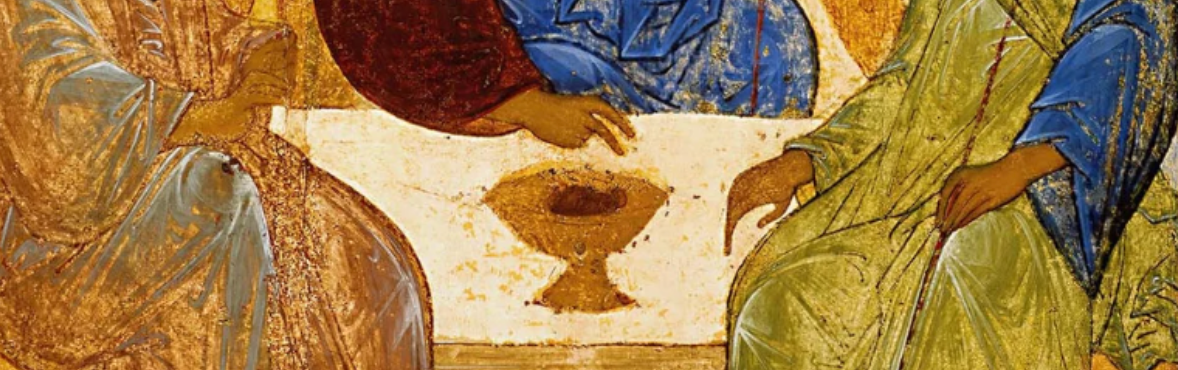
A baby seems to be a necessary icon for us, correcting our eyesight which grows old and struggles to see "the weight of glory" in each other as teenagers, adults, and perhaps especially, as old people. Even though he did not reference icons in his essay,
we seem to drift very easily into what could be called a type of iconoclasm, an inability to see each other as image bearers of God Himself.
William Wordsworth describes us as "trailing clouds of glory" when we first arrive here "from God, who is our home." But soon, he says, "shades of the prison-house" begin to smother us, and we forget. "We bow to grown people," says Chesterton in this same essay, "take off our hats to them, refrain from contradicting them flatly, but we do not appreciate them properly."
God speaks to us,
like we are working through in St. John of Damascus, through the "cataphatic or apophatic spectrum of theology," or literally from the spoken word (cataphatic) or unspeakable word (apophatic). Apophatic I noticed has the same root in Greek as Infant does in Latin. Both mean "unspoken."
God has given us both bibles and babies, speechless wonders through which He means to unglaze our eyes and fill us with astonishment.
MARK C. WATNEY is professor emeritus at Sterling College, assisting in its newly established C. S. Lewis Center. He has given papers at Harvard's Center for Hellenic Studies and Dordt College
Share this Post on Your Preferred Platform