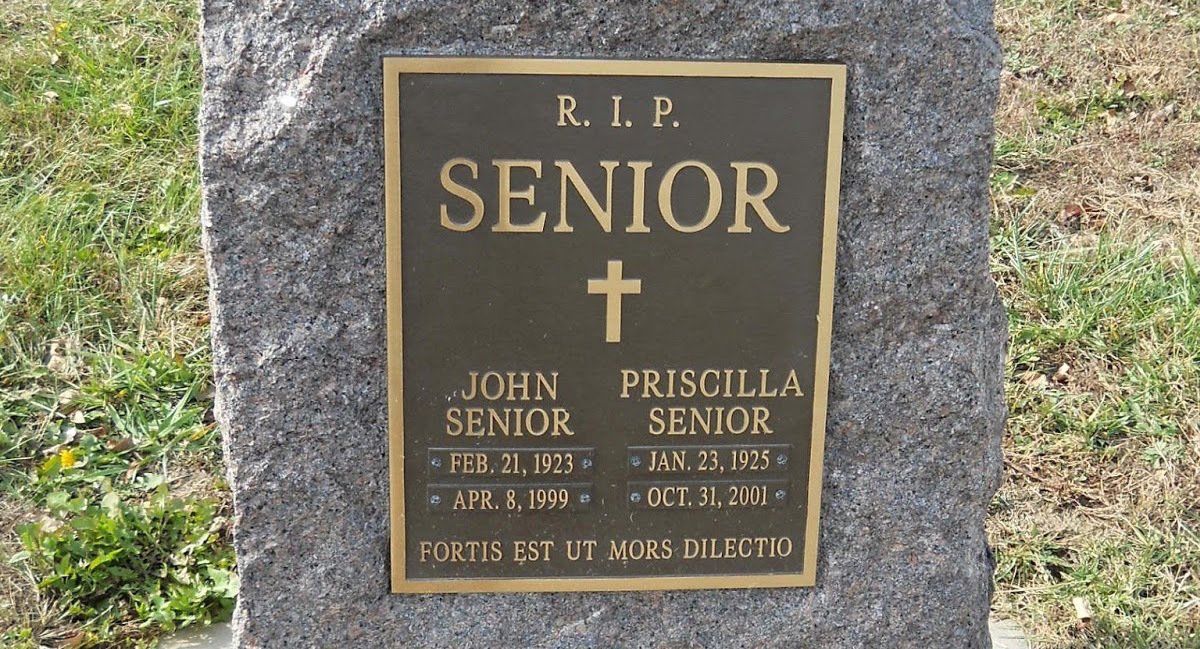
Director's Desk: A Toast to John Senior
Defender of Realism & Professor of Integrated Humanities
ONE OF MY
great heroes was presented at the Hall of Men last evening. Dusty Gates, Director of Education at the Spiritual Life Center and Adjunct Professor of Theology at Newman University, gave an excellent and inspiring presentation on John Senior. If you don’t know who John Senior is, you need to listen to the lecture (forthcoming to Eighth Day Members in new Digital Library) and then read a new book by Fr. Francis Bethel, John Senior and the Restoration of Realism
(available at Eighth Day Books).
Senior was one of three professors at the University of Kansas who in 1970 started the Pearson Integrated Humanities program, a two-year curriculum for freshmen and sophomores. The program was quite controversial and unfortunately was shut down nine years later. Why controversial? Because the teachers believed reality is really real, because they loved the truth, and because they promoted things like faith and honor and modesty and beauty.
For a taste of what Senior and his colleagues created, here are several excerpts from the program’s brochure:
Nascantur in Admiratione . These Latin words on the Pearson emblem (which appears on the next page) mean, “Let them be born in wonder.” To be a student is to be alive to intelligence, and the beginning of such a life is wonder. In our own day wonder has been so cheapened by sensationalism and so crippled by skepticism that the college freshman, instead of being as one newly awakened to the excitement of learning, is often, rather, as one who has never been born. To such a young person learning is so much drudgery and routine, alien to his real interests, remote from reality itself. To revive wonder may be said to summarize the aims of the Pearson Program. Hence it should be regarded as an elementary or elemental course, where one discovers the love of wisdom; a course for beginners, who look upon the primary things of the world, as it were, for the first time.
An ancient philosopher said that to look at the stars is to become a lover of wisdom – a philosopher. Since the Pearson Program aims to make all students philosophers in this sense, we say, with a modern poet,
Look at the stars! Look, look up at the skies!
Not only are students in the Program required to look, literally, at the stars, but they are also expected to look up through poetry and through all that is great in Western Civilization. It is by the light of the stars (or “something like a star”) that we discover the world ourselves and our destination. […]
What is the Person Integrated Humanities Program? It is three professors and two hundred students reading the great books of Western Civilization. It is a four-semester sequence of six credit hour courses designed especially for freshmen and sophomores. The first semester is devoted to ancient Greek authors, the second to Roman, the third to the Bible and Medieval civilization, and the fourth to the modern world. The books are selected to represent various areas of the humanities, especially history, literature, and philosophy. Instead of studying these three disciplines separately, they are considered in relation to each other and to the whole educational process. Students in the Program memorize poetry; they learn the script in which this booklet is written [calligraphy]; they waltz; they may speak Latin. The Program is open to all new K.U. students, and it is designed for all levels of academic ability, not just for “high achievers.” […]
What is the Philosophy of the Humanities Program? It may be called “traditional” or “perennial” in so far as it follows the common understanding of reality which is handed down from Plato and the Bible, through the Christian Middle Ages and the Renaissance into our own times. This understanding has always been challenged, of course, and from the 16th century on, the attacks have grown sharper and more widespread. These challenges to the tradition are also studied in the Program, with a view to forming a just understanding of their force.
The subject of the course is emphatically not the convictions of the teachers, for, as St. Augustine says, “Who would be so stupidly curious as to send his son to school in order that he may learn what the teacher thinks?” What Plato says is far more important than what we say of him, but it is not the point of education to learn even the convictions of Plato. The greatest of Plato’s students, Aristotle, declared that as much as he loved his teacher, he loved the truth still more. […]
The spirit of the Pearson Program may be called Quixotic. Don Quixote has been both ridiculed and admired because he lived the chivalrous life when it was out of fashion. Note – he did not just talk about chivalry: he did it. As he took knight-errantry seriously, so we take Don Quixote seriously – and Odysseus, and all the others. Doing poetry is Quixotic – memorizing and reciting it; being mannerly and waltzing are Quixotic; and so is taking sides. Words like truth and faith and honor and love and courtesy and decency and simplicity and modesty are Quixotic, and the realities for which these words stand are, in this Iron Age, so Quixotic as to be positively despised by the sophisticated. The Pearson Program asserts that such realities are no sentimental “impossible dream,” no crazy anachronism, but rather the objects of an entirely possible dream which is the paradigm of sanity.
Why Read the Great Books? On this question the judgment of Western Civilization is in. Not to know Homer and Plato and Virgil and Caesar and the Bible (to list no more) is simply to be uneducated. Merely to know about them is comparable to knowing about food without actually eating any. To know them in fragments is to be fragmentarily educated. It is worth repeating, however, that knowledge of books is not the aim of education. The books themselves aim at an understanding of the permanent things, the things which every person encounters in life. […]
I FIRST read this brochure in 2006, shortly before organizing Eighth Day Institute’s first activities (lecture-and-film series, a “Bible and the Fathers” reading group, and an iconography workshop). John Senior and the Pearson Program have deeply shaped my vision for Eighth Day Institute. And as we develop the Catechetical Academy, I assure you that, regardless of how controversial the Pearson Program may have been (and would definitely still be today, far more so), the shape and curriculum will be explicitly influenced by Senior and his Integrated Humanities Program. You might even consider it as an attempt at a sort of Pearson Program version 2.0.
So I was delighted to propose a toast to John Senior at the conclusion of last night’s Hall of Men, as I do to most all heroes at Hall of Men meetings. I’ll offer that toast again here:
To John Senior, Defender of Realism and Professor of Integrated Humanities Who Believed a Cup of Coffee with a Cowboy Was Something Like Perfection! (see quote below for the coffee reference)
And since I have the opportunity to repeat the toast, I’ll make an addendum:
To John Senior, the Patron Hero of Eighth Day Institute!
The immediate (practical purpose of drinking a cup of coffee is to wash the biscuit down. Its proximate (ethical) purpose is the intimate communion of, say, cowboys (they do exist; Will James was right!) standing around the sullen campfire in a drenching rain, water curling off Stetsons, over slickers, splashing on the rowels of spurs, as they draw the bitter liquid down their several throats into the single moral belly of their comradeship. The remote (political) purpose of coffee at the campfire, is the making of Americans—born on the frontier, free, frank, friendly, touchy about honor, despisers of fences, lovers of horses, worshipers of eagles and women.… The ultimate purpose is spiritual. For a boy to drink a can of coffee with cowboys in the rain is, as Odysseus said of Alcinous’s banquet, something like perfection. ~John Senior, “The Restoration of Innocence”
Click here for full content of IHP Brochure
Feast of Carpos and Alphaeus, Apostles of the 70
Anno Domini 2017, May 25
Erin Doom is the founder and director of Eighth Day Institute. He lives in Wichita, KS with his wife Christiane and their four children, Caleb Michael, Hannah Elizabeth, Elijah Blaise, and Esther Ruth.
Share this Post on Your Preferred Platform