Abraham begot Isaac...Jacob begot Joseph...
by Erasmo Leiva-Merikakis
Commemoration of the 14,000 Infants (Holy Innocents) Slain by Herod in Bethlehem
Anno Domini 2023, December 29
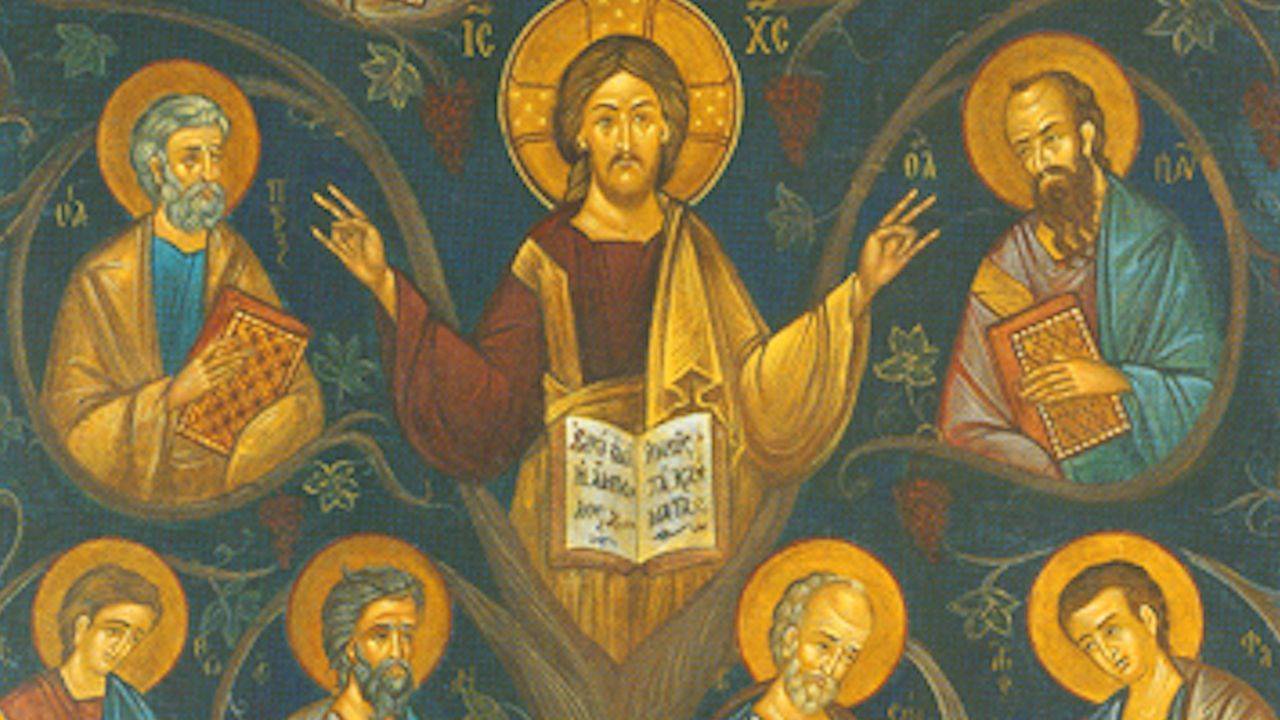
Abraham begot Isaac… ~St. Matthew 1:2
Matthew calls his whole book the βίβλος γενέσεως of Jesus Christ, the book of the “genesis” of His ancestors, of His birth, of His coming among us and its manner, which reveals the promise He holds for us. How fitting that the first sentence of the canonical New Testament, the story of man’s re-creation through the grace of Christ, should contain the word “genesis,” which hearkens back to the first creation of the world out of nothingness. The Virgin Mary is called the βίβλος τοῦ λόγου τῆς ζωῆς (the “book of the Word of life”) by the Greek Church (idiomelon for Great Vespers of the Feast of the Nativity of the Theotokos, Sep 8). The book of the Gospel, the book of Christ’s origins and life, can be written and proclaimed because God has first written His living Word in the living book of the Virgin’s being, which she has offered to her Lord in all its purity and humility—the whiteness of a chaste, empty page. If the name of Mary does not often appear in the pages of the Gospel as evident participant in the action, it is because she is the human ground of humility and obedience upon which every letter of Christ’s life is written. She is the Theotokos, too, in the sense that she is the book that bears, and is inscribed with, the Word of God. She keeps her silence that He might resonate the more plainly within her.
Christ’s genealogy, His entering the human condition and being born a man like us, is indeed the genesis of redemption. The orderly enumeration of the generations imposes a strict symmetry that draws attention to the providential preparation of Christ’s advent through the centuries: the whole history of Israel is seen in retrospect as having led up to the Savior’s Incarnation and birth. God creates and transforms from what He had already created; He does not contradict Himself, nor does He scrap everything at a troubled moment in order to start again “from scratch.” His Son is born within time from a race of saints, sinners, ruffians, exiles, wise men, poets, quarrelers. Even David, the Hebrew letters of whose name add up to the number fourteen and thus determine the structure of Jesus’ genealogy (three sets of fourteen generations each), was not only a great king, poet, and lover of God but also a great sinner—a murderer and a slave to his lusts.
Generation after generation, the father begets his son. The latter, in the accusative case as the grammatical object of the verb, is always the passive recipient of life. Suddenly, arriving at Christ the Lord, the genealogy changes its narrative mode: Jesus becomes the active subject of the sentence. We do not read here that “Joseph begat Jesus” or even that “Mary gave birth to Jesus,” although this latter statement is certainly true. Matthew wants to emphasize that the birth of Jesus occurs, not simply as a result of human reproduction, “from the will of man,” as St. John says (1:13), but from God and by the deliberate intervention of God. Thus we read (v. 16) that “Jesus, called the Messiah, took his birth from Mary,” as a king undertakes an action with sovereign freedom. Christ, the sun of justice, comes forth from Mary “like a bridegroom from His chamber and like an athlete hopeful to run His course” (Ps. 18:6).
Jacob begot Joseph the husband of Mary, from whom Jesus was born. ~St. Matthew 1:16
The name of the Lord suddenly emerges at the very end of the sentence in the nominative case as free and lordly subject of action, concluding the three lists of fourteen generations each. The nominative [subject] supplants the accusative [object], and divine intervention supplants the order of nature. From within the darkness of the world and the vicissitudes of history, and yet rooted in them, the Word of God leaps forth as if by His own deliberate design. History has been for Him. Both the faith of Abraham and the royalty of David—who sum up the whole genealogy already in verse 1—are united and fulfilled in Christ. While, in human generation, it is always the ancestors who ennoble the name of their descendants, in the case of Christ it is this latest comer into the world who makes even His most obscure ancestor famous and reveals the reason-for-being of the whole line. Who, after all, were Shealtiel and Abiud and Zadok for their names to have been inscribed on the first page of the most extraordinary literary document of all time? And if the Word of God waited for forty-two generations in order to com “when time had taken a downward plunge” (cursu declivi temporis), as the Advent hymn has it, it is because God, like a good physician, comes when He is most needed: somehow, to be fully rejuvenated, the world first had to grow old utterly and come to the limit of its own foolish hopes. Christ is sent by the Father into the world “to liberate the human race from its state of decrepitude” (Collect, first Saturday of Advent).
But, at the same time, what tremendous dignity God acknowledges mankind to possess when He reveals to it a mystery that has been contained within the very fiber and flesh of generation after generation! God reveals to man not only the being of God: God reveals man to himself in all his hidden possibilities. Who could have foreseen that a woman of our race could become the mother of the eternal God’s only Son? Who could have suspected humanity’s hidden talent to be able to bear God, not as a cup bears water or as the hand bears a weight, but in the most intimate, physiological sense possible: as a mother bears her child, with everything that implies for the interpenetration of two beings? And so we sing at Midmorning Prayer during Epiphany Week: “The mystery that had been hidden for ages and generations has now become manifest.”
Without knowing it, each of us is a bearer of mystery like Shealtiel, Abiud, and Zadok, even though we are even more anonymous than they. Each of us, too, is caught up in a genealogy, both biological and spiritual, and we each bear the tremendous Mystery that is the personal presence of God among us and within us. As the early Christians like to style themselves, we are “theophores.” In time God does reveal to us, too, what He had hidden in us from the beginning. But who has the patience to await this revelation in silence? Truly, we are almost wholly ignorant of who we are and what promises sleep deep within us.
Joseph is said to be the husband of Mary, “from what Christ was born [ἐγεννήθη].” Christ comes forth sovereignly from Mary. The primacy the fathers hold in every other generation passes here to the woman, the mother, who until now had been treated as mere medium for her husband’s fatherhood. God, for His part, appears as supremely free both in choosing to use human history to prepare His Son’s advent and also in His regal autonomy from the cycle of human generation. Christ is a Jew, and also the one Son of the only God. He belongs to time while not ceasing to be eternal. He is at once mortal and immortal, the holy bearer and personification of God’s mystery of condescension and salvation. (59-61)
*Erasmo Leiva-Merikakis, Fire of Mercy, Heart of the Word: Meditations on the Gospel according to Saint Matthew, Vol. 1 (Chapters 1-11) (San Francisco, CA: Ignatius Press, 1996), pp. 57-61.
Share this Post on Your Preferred Platform