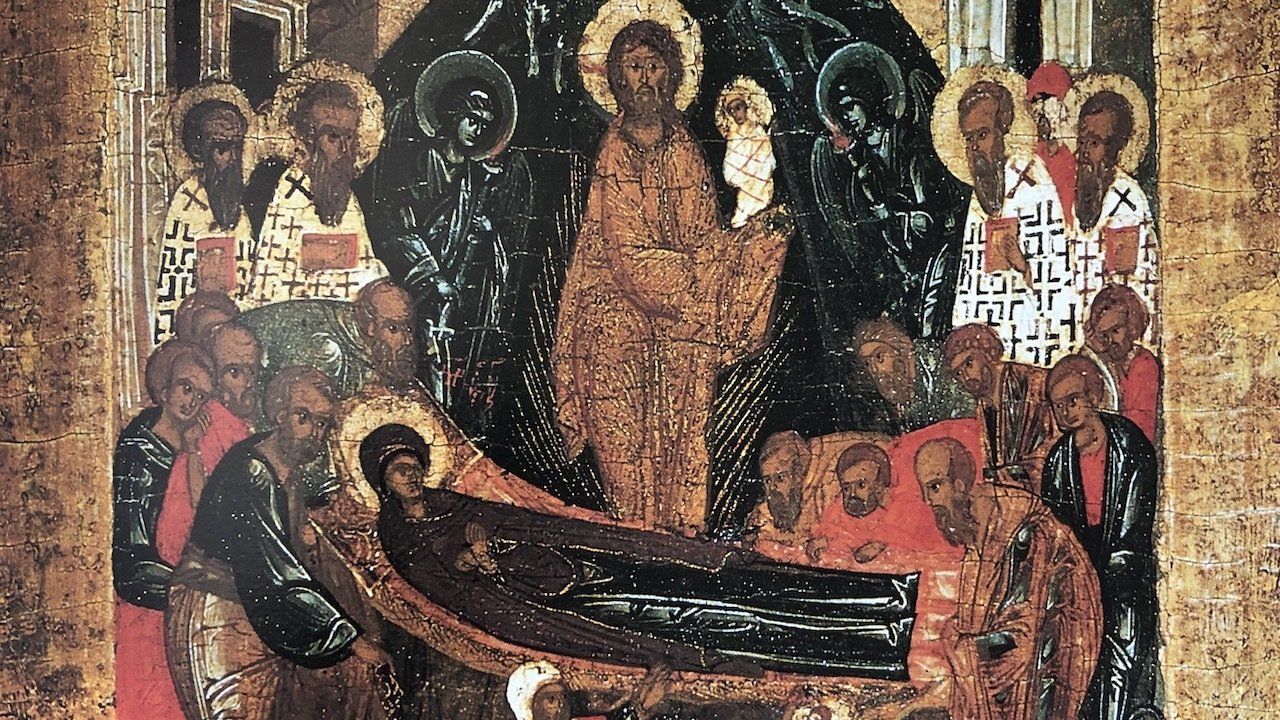
Canon for the Dormition of the Mother of God
by St John of Damascus
Feast of the Seven Holy Youths of Ephesus
Anno Domini 2023, August 4
Ode 1 – First Song of Moses (Ex. 15:1-9)
I open my lips today:
Fill them, O Spirit, with energy
To utter this hymn to the Mother who governs us,
To cry out among the throng of those who praise her,
And join them in singing the wonders we celebrate!
Come, maidens and choristers,
Join with the prophetess Miriam
And raise up your voice in the song of her exodus;
For this virgin now, God’s Mother, who is peerless,
Has come to the goal of her heavenward pilgrimage.
As heaven made womanly,
Heaven itself now has welcomed you
And leads you, most holy one, into its sanctuary;
There you stand beside the King in robes of splendor,
God’s bride, without wrinkle or spot, for all ages.
Ode 3 – Prayer of Hannah (1 Sam. 2:1-10)
All those, Mother of God, who would acclaim you,
O living, undying spring of life,
You strengthen charismatically:
Give them the power to celebrate,
Crowning their minds with glory by
The holy touch of your memory.
Descended from mortals like your brethren,
You showed us an exodus from death,
A pathway supernatural;
Mother of Christ, the source of life,
You have now crossed death’s barrier
To life divine, in reality.
Apostles, evangelists were gathered
Along with the angels from on high
To Sion’s mount, your dwelling-place:
Brought at the nod of Providence—
Rightly, my Queen, and fittingly,
To join the rites of your funeral.
Ode 4 – Prayer of Habakkuk (Hab. 3:1-19)
Lord of highest heaven, Your mysterious will
Stood before the ages: to come to us
Born of a virgin;
Holy Habakkuk exclaimed,
Full of prophetic clarity,
“Glory to Your power and goodness, Lord!”
Shaken with amazement to see on the earth,
Raging through the valleys like animals,
Whirlwinds from heaven,
Living creatures of the King,
He cried, “How great Your handiwork!
Glory to Your power and Your goodness, Lord!”
Taking you to heaven, O Mother of God,
Covering your holy and receptive, God-Welcoming body
With their many-splendored wings,
Angelic hosts surround you,
Shielding you with radiant modesty.
Once her very offspring, mysterious God—
He of whom the heavens gave prophecy—
Died and was buried,
Sharing willingly our lot;
She, too, must share the sepulcher,
She who had conceived Him in purity!
Ode 5 – Prayer of Isaiah (Is. 26:9-20)
The world is revivified,
Seeing your holy majesty;
You, unmarried mother, holy virgin,
Rise now above us, into your heavenly home,
Ascending to life without an end:
Grant to all who sing to you
Everlasting vitality.
Evangelists, waken us,
Sounding your trumpets joyfully!
tongues of many nations, sing her praises,
Tell of her glory; let there be joy in the air,
And let it be radiant with light;
Angels, sing the mystery
Of the death of God’s holy one.
O vessel of Providence,
Truly such praise is justified;
All of your virginity has risen,
Homeward to heaven, completely radiant with God:
For us, you are a source of holy light,
Holding and revealing God
As His mother most glorious.
Ode 6 – Prayer of Jonah (Jonah 2:2-9)
Come here, good friends, let us celebrate,
With all of God’s own faithful and holy ones,
Mary’s great festival;
Come, sing to Christ, who was born of her,
Clapping our hands to praise Him:
Glory to both of them!
From you the flower of life sprang forth,
Not bursting the gates of your virginity;
Source of vitality,
How could your temple immaculate
Ever be made to share in
Death’s dissolution?
You sheltered life as its sanctuary;
Now life without end is your inheritance,
Life is your dwelling-place.
Crossing this river of mortality,
You who call life your offspring,
Share His eternity.
Ode 7 – Prayer of the Three Holy Children (Dan. 3:26-56)
When commanded to adore Him who created them,
Three sons of Israel
Chose, in their courage, to defy even furnaces,
Braving the fire, as they sang exultantly,
“Praised be the God of Abraham; may the Lord be blessed forever!”
Come, young men and gentle maidens, join the festival;
Honor that maiden, the
Mother of God today; come elders and emperors,
Masters and magistrates, join our canticle:
“Praised be the God of Abraham; may the Lord be blessed forever!”
Let the mountains, in the Spirit, blow a trumpet-call,
Fanfares and flourishes;
Joyously dancing like the hills, let the Apostles now
Leap in their revelry; let our banqueting,
Sacred to Mary’s memory, fill this day with consolation.
For the wonderful transition of Your Mother, the
Holy and spotless one,
Calls to our revelry heaven’s company:
Angels and archangels join our festival,
Singing with us the canticle: “May our God be blessed forever!”
Ode 8 – Song of the Three Holy Children (Dan. 3:57-88)
The lads who were cast into the furnace
Were rescued by Mary’s Son, who guides the universe—
Then by a prefiguring, now becoming flesh in her,
Waking the world to victory, inspiring anthems of praise;
O come, acclaim the works of the Savior,
And call Him blessed forever and forever!
Your name, too, O spotless, holy Virgin,
The powers and principalities now celebrate,
Angels with the archangels, thrones and dominions all,
Cherubim, too, and seraphim, aglow with awe-struck, burning acclaim;
So we, mere men and women, dare praise you
And call you blessed forever and forever!
The One who has mysteriously entered
Within you, to take His flesh from your virginity,
He it is who welcomes you, taking your immaculate
Soul in His hands, embracing you—a loving, dutiful Son.
How justly we exalt you, holy Virgin,
And call you blessed forever and forever!
O marvel of marvels past all knowing:
God’s mother and yet a virgin, you are wonderful!
Entering your sepulcher, you leave it as a paradise!
All who today are privileged to gaze in joy at that tomb
Acclaim her, and acclaim Him who made her,
And call them blessed forever and forever!
Ode 9 – Song of the Theotokos (Magnificat: Lk. 1:46-55)
Come now, bring a torch, come join the festivity,
Sons of mortality;
Dance in exultation now, O race of spirits free of our history,
Acclaim the great transition of her who is Mother of God.
Let us greet her: “Hail to you, most holy One,
Virgin Mother of God for eternity!”
Come now to this shrine, this mountain of holiness,
Sion all-glorious;
Today let us celebrate, our faces shining with Mary’s radiance!
For to a greater sanctuary, and to a holier tent
Christ now brings His tabernacle glorious—
To the temple in heaven’s Jerusalem.
Come, people of God, draw near to this sepulcher
Filled with her memory;
Show it veneration with the lips, the eyes, the heart of fidelity,
And in sincere humility, let us now draw from this spring
Of God’s healing, spiritual probity—
Let us drink of God’s gifts at His mother’s tomb.
Take from our hands this solemn processional,
Mother of mysteries!
Keep us in the shade of your protecting hand, from shadows deliver us;
And to our king give victory, to all your people give peace,
To us sinners, pardon and deliverance:
Bring us all to that bliss which we celebrate!
*From On the Dormition of Mary: Early Patristic Homilies, translated by Brian E. Daley (Crestwood, NY: St Vladimir’s Seminary Press, 1998), pp. 241-246. Available for purchase at Eighth Day Books.
Share this Post on Your Preferred Platform