Dominion of Death, Healing Presence, Spring, & Imitation of Christ as Care for Neighbor
by Erin Doom
Feast of St Hypatius, Bishop of GangraAnno Domini 2020, March 31

1. Essays & Reflections: R. R. Reno, editor of First Things, initiated an important conversation a week ago when he published a provocative post titled
“Say ‘No’ to Death’s Dominion.”
According to Reno, “There is a demonic side to the sentimentalism of saving lives at any cost. … the mass shutdown of society to fight the spread of COVID-19 creates a perverse, even demonic atmosphere.”
Are lockdowns and social distancing a cowardly surrender to “death’s dominion”? After seeing a Tweet by NY Governor Cuomo – “My mother is not expendable. Your mother is not expendable. We will not put a dollar figure on human life” – Rod Dreher at The American Conservative
responds with an emphatic “Yes!” Dreher: “When the Catholic editor of the leading conservative Christian magazine allows the fanatically pro-abortion Andrew Cuomo to outflank him on the issue of the sanctity of human life, well, we have a problem.” Read the whole response here.
2. Essays & Reflections: Brad Littlejohn, President of The Davenant Institute and Visiting Assistant Professor of Political Theory at Patrick Henry College, also responds to Reno.
According to Littlejohn, Reno’s position
“puts conservative Christians in a somewhat awkward position. After all, have we not spent decades denouncing the ‘culture of death’ that was more than happy to sacrifice the lives of the weak unborn, the vulnerable, and the inconvenient elderly for the pursuit of freedom, wealth, and material comfort. Now, it looks – at first glance at any rate – that the same Christians are denouncing as a ‘culture of death’ a society that is prepared to sacrifice freedom, wealth, and material comfort in order to preserve the lives of the weak, the vulnerable, and the elderly.”
The question, then, is do we have a duty to be fearless in facing death, as Reno suggests, or appeal not to self-love but love of neighbor, as Dreher and Littlejohn suggest? Or framed better by Littlejohn: “is it more loving to our neighbor to increase the number of people who will get sick and die in the near term, or to decrease our economic well-being in the near-term (thus, presumably, increasing sickness and death in the long run)?” For his answer, Littlejohn turns to The Lord of the Rings.
Read the whole piece here…it’s well worth your time.
3. Essays & Reflections: One more response to Reno (of many) that's worth your time: Timothy O’Malley’s “The Church’s Response Is Saying ‘No’ to Death’s Dominion,”
which argues that if we operate out of a hermeneutics of fear and focus exclusively on the darkness, we miss the presence of sacrificial love. Here’s O’Malley:
"A sacrificial orientation towards society will need to be cultivated after COVID-19. The world itself, as well as our nation, is primed for a renewal of the virtue of solidarity, of the bonds of communion that define what it means to be a human being. For the first time in decades, most of us in the United States are united in a transcendent project, a task that extends beyond my individual trip to Florida for spring break or my mimosa-filled brunch on Sunday-Funday. I am seeking the well-being of my neighbor, even if I do not know his or her name. I am offering a gift of quarantine, a gift of which there will be no immediate return.
Here, the Church has a specific vocation to place in the days after COVID-19. It is to fan the flames of this almost Eucharistic solidarity, a spirit of fraternal connection, that unites us the world over."
O’Malley suggests that post-COVID-19 the Church may have an opportunity to engage the political sphere with a different message related to the dignity of life. With pro-choice politicians like Gov. Cuomo already using the language of sacrifice and dignity of life (cf. Tweet above), without fully comprehending the logic or foundation underlying their arguments, we may have an opportunity to flip the tables on them: “If we can shut down restaurants, professional sports leagues, businesses, and every dimension of society to save a single life, then why can we not find a way to save the life of a single unborn child? To support families who seek to offer life to children? A migrant who has come to the borders? To care for the elderly who are tempted to pursue assisted suicide because they are treated not as a gift but as a burden?” Read the whole piece here.
4. Eighth Day Books Review:
Albert Rossi, in his book Becoming a Healing Presence, argues that our task is to surrender, to become a conduit through which God’s healing fire reaches others. And the keys he suggests for such a life have been forced on most of us in recent days: simplification, or as he calls it, “subtraction." Read the full review here, buy a copy from Eighth Day Books, and may our forced “subtraction” make us into a conduit of God’s healing fire.
5. Poetry:
Thank God spring is here. Today’s poem by Gerard Manley Hopkins is titled “Spring.” Read and contemplate it here.
6. Bible:
Is. 40:18-31, Gen. 15:1-15, Prov. 15:7-19. Online here.
7. Liturgy:
Today is the feast day of St. Hypatius, Bishop of Gangra in Paphlagonia (in the north of Asia Minor). He was present at the First Ecumenical Council at Nicaea (A.D. 325) and was renowned by all for his pious life and miracle-working. The Emperor Constantius ordered that a likeness of Hypatius be made during his lifetime. The emperor kept this likeness in his palace as a weapon against all adverse powers. Once, upon returning from Constantinople, Hypatius was attacked in a narrow gorge by Novatian heretics and was thrown from the road into the mud. At that moment a woman from that group struck him in the head with a stone, and thus the saint died. Immediately the woman went insane and took that same stone and struck herself with it. When they took her to the grave of St. Hypatius, he interceded before God on her behalf. She was healed by the greatly compassionate soul of Hypatius, and lived the remainder of her life in repentance and prayer. St. Hypatius died and took up his habitation in the Eternal Kingdom of Christ our God, in the year 326. ~The Prologue of Ohrid
8. Word from the Fathers:
This is the rule of most perfect Christianity, its most exact definition, its highest point, namely, the seeking of the common good ... for nothing can so make a person an imitator of Christ as caring for neighbors. ~St. John Chrysostom
*If you’d like to receive the Daily Synaxis
in your inbox Mon-Fri, you can subscribe here.
**All books (and icons) in print available from Eighth Day Books.
Please support an independent bookstore that believes in the eighth day resurrection of our God and Lord and Savior Jesus Christ. Give them a call at 1.800.841.2541 or visit their website here. And don't forget Eighth Day Members
(Patrons+) receive 10% discount, plus lots of other perks!
Share this Post on Your Preferred Platform

Inside the head of my three-month-old granddaughter, Lucy, said G.K. Chesterton is, "a new universe, as new as it was on the seventh day of creation...a new system of stars, new grass, new cities...and new seas." And this is because, he adds: The gravity of astonishment at the universe...dwells in the eyes of a baby three-months-old [and] the universe is put upon its trial and forces us actually to remodel our conduct...we seem to be dealing with a new race, only to be seen through a microscope...[with] delightful bulbous heads, three times too big for the body. But Chesterton's central thesis in this essay is not that babies are so marvelous, but that our treatment of each other as adults, in contrast, is so broken. "It is our attitude towards grown-up people that is wrong," he writes, because we no longer see each other with astonishment and wonder (unless, that is, we are falling in love). But babies remind us that humans really are astonishing, and this "revolutionary theory of the marvelousness of all things" should force us to "remodel our conduct" toward everyone we meet. A baby seems to be a necessary icon for us, correcting our eyesight which grows old and struggles to see "the weight of glory" in each other as teenagers, adults, and perhaps especially, as old people. Even though he did not reference icons in his essay, we seem to drift very easily into what could be called a type of iconoclasm, an inability to see each other as image bearers of God Himself. William Wordsworth describes us as "trailing clouds of glory" when we first arrive here "from God, who is our home." But soon, he says, "shades of the prison-house" begin to smother us, and we forget. "We bow to grown people," says Chesterton in this same essay, "take off our hats to them, refrain from contradicting them flatly, but we do not appreciate them properly." God speaks to us, like we are working through in St. John of Damascus , through the "cataphatic or apophatic spectrum of theology," or literally from the spoken word (cataphatic) or unspeakable word (apophatic). Apophatic I noticed has the same root in Greek as Infant does in Latin. Both mean "unspoken." God has given us both bibles and babies, speechless wonders through which He means to unglaze our eyes and fill us with astonishment. MARK C. WATNEY is professor emeritus at Sterling College, assisting in its newly established C. S. Lewis Center. He has given papers at Harvard's Center for Hellenic Studies and Dordt College
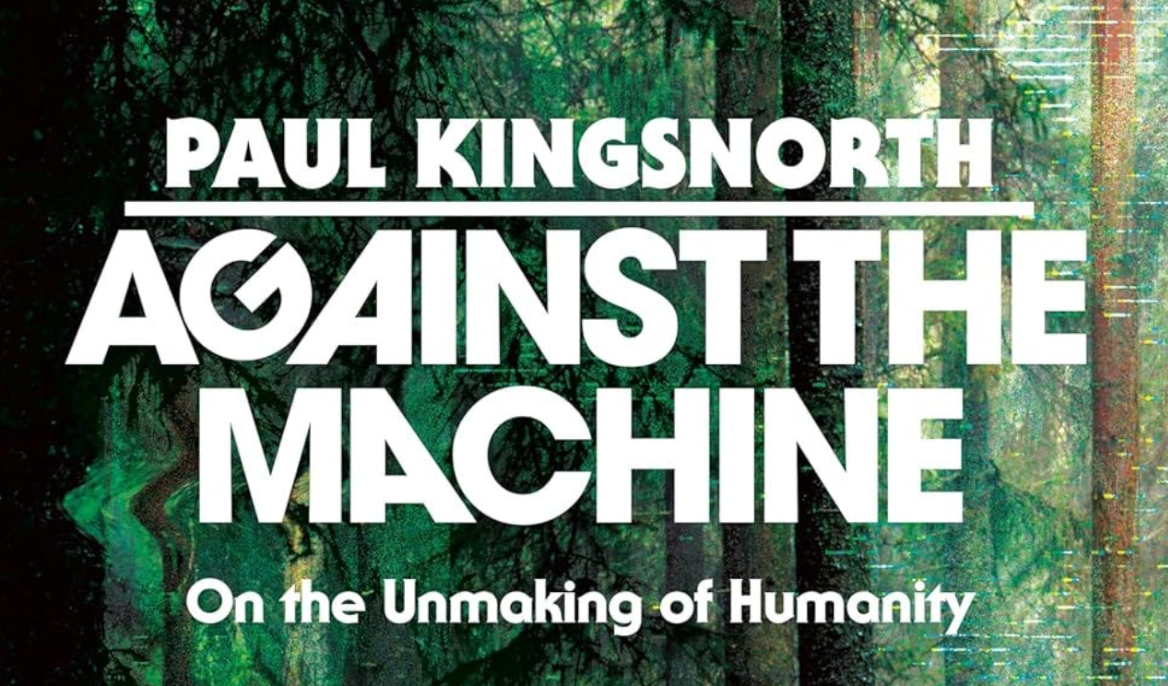
"God became man, so that man might become God." St. Athanasius the Great, On the Incarnation (54:3) These words from St. Athanasius may sound, at first blush, provocative. However, St. Athanasius is restating, perhaps more simply, what St. Peter says in his second epistle: the promise of being united to Christ is that men and women made in His image will partake in His divine nature (2 Peter 1:4). Paul Kingsnorth's latest book, Against the Machine, inverts this idea and opens our eyes to the world emerging at a rapid rate, the world dominated by what he calls The Machine. The new mantra of The Machine age is, instead, this: Man will become God by Man's own self-creation. Reading Kingsnorth is not for the faint of heart. It's easy to be overcome by despair. The goal of the Machine age is "transhumanism", to be liberated from the constraints of the body. For the transhumanist (self-described), the future is disembodied. The future is limitless. But this is not liberation. Because the Machine is not limited to the physical world, it follows naturally there is a spiritual nature to this lifestyle, what he ultimately identifies as a manisfestation and/or manipulation of the demonic. Whether or not you agree with his ultimate conclusion, we can see its effects. An entire generation, and many across generations, addicted to screens. Disintegration of communal life, most disastrously in the breakdown of the family. Increasing rates of loneliness, depression, and suicide, especially among children. It's clear we need a Savior, and the Machine isn't it. Instead, Kingsnorth encourages us toward a revival of community, men, women, and children living embodied lives in the same space and time: working together, eating together, worshipping together, loving each other, carrying each other's burdens. If this sounds like Eighth Day Institute...if this sounds like what the Church is meant to be, it is because this is exactly what the Church is. We are saved together in Christ. MICHAEL SIMMON currently serves as the Secretary of Eighth Day Institute Board of Directors and Coordinator for Hall of Men. He resides in Wichita, Kansas with his wife and four children.
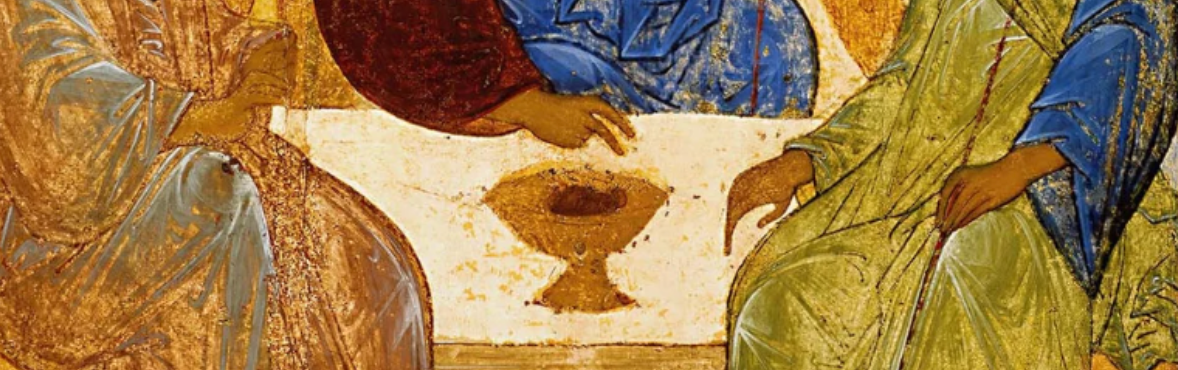
"What is it that has ordered the things of heaven and those of earth, the things which move through the air and those which move in the water; nay, rather the things which proceeded them: heaven and earth and the natures of fire and water? What is it that combined and arranged them...set them into motion and put them on their unceasing and unhindered course?..But who is the architect of these things? Or did not he who made them also bring them into being? We shall certainly not attribute such power to spontaneity." On the Orthodox Faith, Chapter 3 This comes after St. John of Damascus sets out to delineate between the created and the uncreated, a fact which, while at the core of existence, seems for him to be, for this very reason, the simplest to believe. Everything but God is created and, thus, susceptible to change. This means people, but this also means demons, angels, the rest of the created order across the entire cosmos. Everything is vulnerable to unrest. Except for God. If you have ever tried to explain the Holy Trinity to a child for the first time, maybe you have felt as I have the weightier, inexpressible side of God's unchangeability: how do I possibly communicate this essential fact to the person in front of me? (This is usually when my faint stutter starts to pop up again.) I like that here, like St. Patrick reaching for a three-leaf clover, St. John brings us back to earth to better understand the cosmos. Fire and water are no less mysteries than heaven and earth. And yet here we are, cooking and washing, eating and drinking, filled and sustained on what we can neither fully explain nor claim to have created. Only God is unchanging. Vice versa, God is the only constant we need. Maybe the rest is better left unsaid. LUKE TAYLOR GILSTRAP is Vice President of the Board of Directors for Eighth Day Institute. His poems have appeared in Spiritus, Ekstasis (Christianity Today), and Relief Journal, among others. He lives happily in Wichita, Kansas with his wife and three sons.

"Now, one who would speak or hear about God should know beyond any doubt that in what concerns theology and the Incarnation not all things are inexpressible and not all are capable of expression, and neither are all things unknowable nor are they all knowable. That which can be known is one thing, whereas that which can be said is another, just as it is one thing to speak and another to know. Furthermore, many of those things about God which are not clearly perceived cannot be fittingly described, so that we are obliged to express in human terms things which transcend the human order. Thus, for example, in speaking about God we attribute to Him sleep, anger, indifference, hands and feet, and the like." On the Orthodox Faith, Chapter 2 When I was studying Fiction in graduate school, one of the first methods I learned to really situate the reader in the story you were about to tell them was disorientation; if you wanted to ground them in one story, first you had pull the rug out from under their feet. So it's fitting that in the beginning of St. John Damascene's On the Orthodox Faith, before rebuilding our foundation, he first puts us squarely in limbo, seesawing back and forth between certainty and uncertainty. To paraphrase, there is no doubt (certainty) that about God some things can be expressed...but not all things (uncertainty). Some things about God are truly knowable (certainty), but some are unknowable (uncertainty). Oh, and while we're speaking about God (certainty), let's admit there's a gap, too, between what we say and what we know (uncertainty). My favorite line in this spiraling excerpt, "...it is one thing to speak, and another to know," takes me back to the final lines in Wendell Berry's poem, "How to Be a Poet," which he wrote primarily as a reminder to himself: Accept what comes from silence. Make the best you can of it. Of the little words that come out of the silence, like prayers prayed back to the one who prays, make a poem that does not disturb the silence from which it came. Wherever your preferences fall on the cataphatic or apophatic spectrum of theology (whether you lean more toward what we can say about God or what we cannot), Berry's poem, I think, would nod along with St. John: before we say too much, let our words be preserved by the silence from which they came. I'm thinking of the silence, that filling, restorative quiet I feel when I step into a cathedral or in some of my favorite moments with my kids in the early hours. Even before praying, can we hear the One already praying in us? Let's start there. LUKE TAYLOR GILSTRAP is Vice President of the Board of Directors for Eighth Day Institute. His poems have appeared in Spiritus, Ekstasis (Christianity Today), and Relief Journal, among others. He lives happily in Wichita, Kansas with his wife and three sons.
Late-Night Bookstores and Spiritual Reading
On St. Benedict and the Making of Vows

The Pursuit of Truth in the Age of AI

On the Theology of Raising Chickens

G.K. Chesterton and Raising Small Children

"Seal of the Fathers"