Homily 6
by St Macarius of Egypt
Feast of St Gregory the Righteous of Decapolis
Anno Domini 2020, November 20
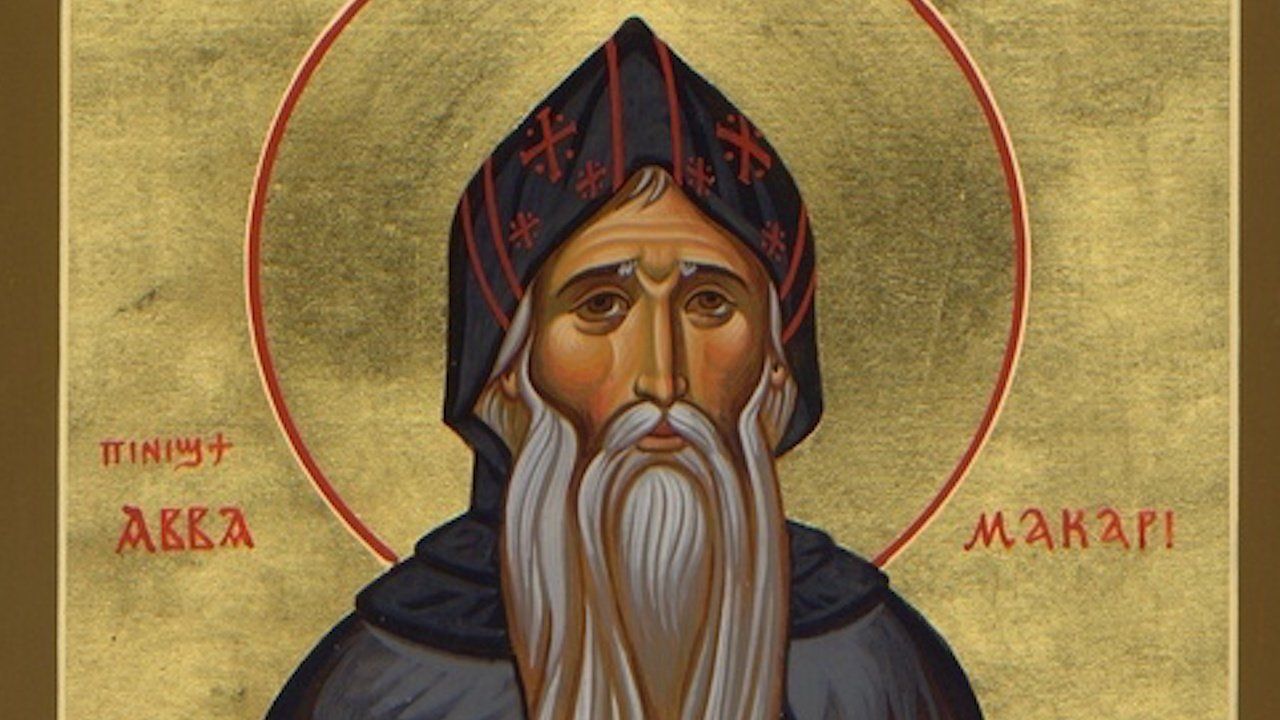
Those wishing to please God ought to pray in peace, tranquility, meekness, and wisdom, so as not to give scandal to all others by their loud outcries. The homily touches also on two questions: whether the thrones and crowns are creatures and concerning the twelve thrones of Israel.
1. Those who approach the Lord ought to pray in quietness, peace, and great tranquility. They ought to attend to the Lord, not using uncalled for or disturbing outcries, but rather with an attentive heart and controlled thoughts. Take the example of someone seriously sick who needs to undergo cautery or a surgical operation. One will bear the pain with courage and patience, self-possessed without any great tumult and disturbance. Then there are others who may be afflicted with the same sickness. While cautery is being applied or they are being cut open by the surgeons, they let out horrendous cries. All the while, both types suffer the same pain, yet one screams and the other is silent, one makes a disturbance and the other none.
There are some who, when they undergo some suffering and affliction, accept it in a tranquil spirit. There are then others who have the same affliction. They accept it with much impatience. They pour out prayers with disorderly noise and agitation so that those who hear them are scandalized. There are others who, although they are not really laboring under any pain, nevertheless, for the sake of ostentation or idiosyncrasy, use unbecoming cries as though by these they can be pleasing to God.
2. It is not becoming a servant of God to live in a state of disturbance, but rather in all tranquility and wisdom as the Prophet said, “Unto whom shall I look but unto him that is meek and quiet and that trembles at my words?” (Is. 66:2). And in the times of Moses and Elijah we find that in the visions granted them, even though there was a great display of trumpets and powers before the majesty of the Lord, still, amidst all of these things, the coming of the Lord was discerned and He appeared in peace and tranquility, and quietness. For it says: “Lo, a still, silent voice and the Lord was in it” (1 Kgs. 19:12). This proves that the Lord’s rest is in peace and tranquility. For whatever foundation a person lays and whatever beginning he makes, he will continue in that until the end. If he begins praying in an exaggeratedly high and screeching voice, he maintains such to the end. Because the Lord is full of love for mankind, it happens that He gives grace even to such a one. Such a type, because of grace, continues in the same procedure. Still, we see that this is the thinking of the uninstructed. As a result, they give scandal to others and are a disturbance to themselves during prayer.
3. The true foundation of prayer is this: to be very vigilant over thoughts and to pray in much tranquility and peace in order not to be a source of offense to others. For such a person, if he received God’s grace, will pray to the end in tranquility and will edify many others much more. “For God is not a God of confusion but of peace” (1 Cor. 14.33). Those who pray with great noises are like coxswains who exhort the rowers to keep time. They seem unable to pray anywhere as they wish, not in churches, in villages, but only perhaps in deserted places.
But those who pray in tranquility are a source of edification to all everywhere. A person ought to labor to concentrate on his thoughts. He must cut away all underlying matter that leads to evil thoughts, urging himself toward God. He should not allow his thoughts to control his will, but he needs to collect them whenever they wander off in all directions, discerning natural thoughts from those that are evil. The soul, being tainted by sin, is similar to a large forest on a mountain or like reeds in a river or thick, thorny bushes. Whoever pass through such a place need to hold out their hands before them and with force and labor push aside whatever lies in their path. So also the thoughts that come from the adverse power beset the soul. Therefore, there is need for great diligence and mental alertness so that one may distinguish those outside thoughts that rise by the power of the adversary.
4. One person may rely totally on his own power, thinking that he can clear the mountains of the brush all by himself. Another controls his mind, keeping himself in tranquility and self-control. Without too much trouble he is more successful than the other. So also in prayer there are some who use unseemly cries as though they were relying on their own bodily grunts and groans, not realizing how their thinking deceives them, namely, that they could ever perfectly obtain success by their own efforts. There are others who attend to their thoughts and enter into an inner battle. By their understanding and discernment these are capable of success as they shake away the attacking thoughts and walk in the Lord’s will.
We find in the Apostle that he says whoever edifies others is greater than he who does not. “He that speaks in tongues edifies himself, but he that prophesies edifies the Church. Greater is he who prophesies than he who speaks in tongues” (1 Cor. 14.4-5). Let everyone, therefore, seek to edify others and he will then be considered worthy of the Kingdom of Heaven.
5. Question: Some people claim that the thrones and crowns are creatures and not of the Spirit. How are we to understand these?
Answer: The throne of the Godhead is our mind and again the throne of our mind is the Godhead and the Spirit. Similarly, Satan and the powers and princes of darkness, after the fall of Adam, have enthroned themselves in the heart and mind and body of Adam as their own special throne. For this reason the Lord came and took a body of the Virgin. If He wished to descend in His divinity, who would have been able to endure it? So He spoke with men through the instrument of His body. In such a way He threw down the evil spirits that had enthroned themselves in the body by means of the intellect and thoughts. And the Lord cleansed the conscience and made for Himself a throne of the mind, the thoughts and the body.
6. Question: What, therefore, is meant by the text, “You shall sit on the twelve thrones, juding the twelve tribes of Israel” (Mt. 19:28)?
Answer: This we find was fulfilled on earth when the Lord was taken up into Heaven. For He sent the Spirit, the Comforter, upon the twelve Apostles, along with His holy power. He came and pitched His tent and took up His throne in their minds. When those onlookers said that they were full of new wine (Acts 2:13), Peter began to judge them, saying of Jesus: “This man, mighty in words and signs, you crucified, hanging Him on a tree” (Acts 2:22). And truly He does amazing things, upturning the tombstones and raising the dead. For it is written: “In the last days I will pour out my Spirit upon all flesh and your sons and your daughters will prophesy” (Acts 2:17). Therefore, instructed by Peter, many came to repentance so that a new world, the chosen of God, came into being.
7. Do you, therefore, see how the beginning of judgment appeared? A new world appeared there. Authority to sit and judge, even in this world, was given to them, the Apostles. And it is granted them also to sit and pass judgment at the coming of the Lord in the resurrection of the dead. Nevertheless, it is also done here, by the same Holy Spirit sitting on the thrones of their minds.
The crowns which Christians will receive in the age to come are not creatures. Those who say this are speaking nonsense. The Spirit uses these in a transfigured sense. What does the Apostle Paul say of the heavenly Jerusalem? “This is the mother of us all whom we all together confess” (Gal. 4:26). In regard to the garment which Christians wear it is evident that the Spirit clothes them in the name of the Father and the Son and the Holy Spirit forever. Amen.
Share this Post on Your Preferred Platform