Influenza: History Matters
by Mark Mosley
Feast of St Tikhon, Patriarch of Moscow & Enlightener of North America; Holy Tuesday in WestAnno Domini 2020, April 7
DURING A
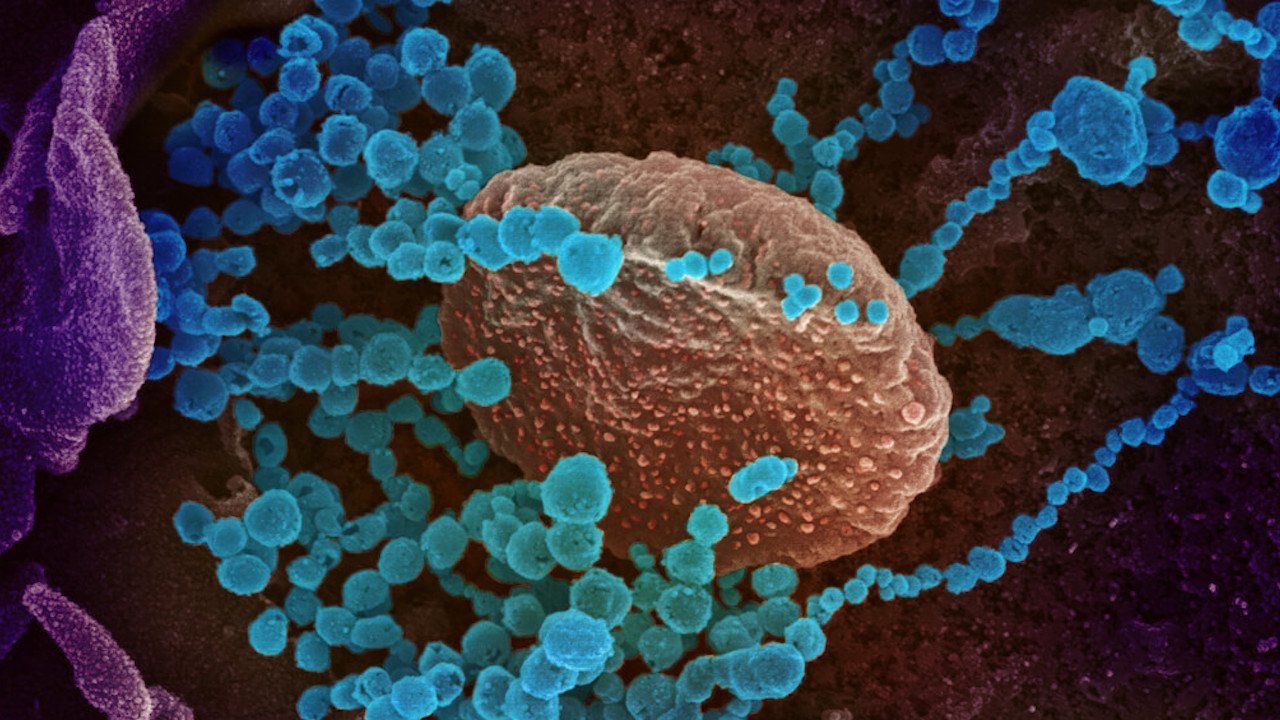
a few months in 1918, more people died of influenza than any other illness or plague in recorded history. World War I (1914-1918) claimed an estimated 16 million lives. The influenza epidemic of 1918 killed over 50 million people. Nearly one out of every three persons on the earth was infected. It is not an overstatement to say that it is the most devastating natural disaster in history (barely covered in many history courses).
The name “Influenza” comes from an epidemic in 1357 in Florence, Italy. Derived from the medieval Italian word for “influence” (influentia), the word “influenza” refers to the causes or influences of the disease. According to the Oxford English Dictionary, the causes were originally believed to be astrological. Eventually, however, unusually cold weather came to be considered the primary explanation for this pandemic and was called “Influenza di freddo” (“influenced by cold”). The term “Influenza” has since come to be used universally for this now-known viral illness.
In 1892, Dr. Richard Pfeiffer isolated an unknown bacterium from the sputum of his sickest influenza patients, believing this to be the cause. He called it “Pfeiffer’s bacillus” or “Haemophilus Influenza.” This well known bacteria is not the cause of Influenza, which is a viral illness; nevertheless, we still use this misnomer today.
In 1918, it was dubbed the “Spanish Flu” because its first reports came from the Iberian Peninsula (Spain). We now know this is not
where it started.
Both Allied and Axis news sources during World War I wanted to print only encouraging news and thus withheld knowledge
of influenza outbreaks. Spain, which was not involved in WWI, was free to report on the pandemic and became responsible for its first reports. This led Americans to believe the outbreak was brought to the U.S. by Europe-an immigrants (which was used politically). The calls for “social distancing” and isolation were taken lightly, particularly by businesses that would be hurt by such actions. Political leaders failed to understand the potential impact, and down-played the devastating “influence” this infection could have on a community. This insert is from the collection of the national WWI Museum and Memorial:
Though New York City was in the throes of the pandemic by early October, Health Commissioner Royal S. Copeland repeatedly downplayed the situation, seemingly to mitigate public alarm. When the city reported 999 new cases on Oct. 4, he claimed, even so, that there were “no alarming symptoms about the spread of influenza in New York.” When on Oct. 6 the city experienced 2,070 new cases, he announced, nevertheless, “I do not believe that the city is stricken.” Whether speaking out of ignorance or hubris, such guidance did little to protect the public. Copeland would wait into the next week to finally establish an Emergency Advisory Committee. In other communities, businesses proved restive under the public health restraints. In Globe, Ariz., Wichita, Kan., and Terra Haute, Ind., theater owners fought against closures in courts. Still other locales found citizens resistant to public health controls. In San Francisco and Seattle people chafed under rules requiring the wearing of masks in public spaces.
The reality is that it likely started in Kansas! On March 11, 1918, the first report of many people coming down with influenza came out of Haskell County. One of them was a soldier sent to Camp Funston near Fort Riley. Later that same month, 1,100 soldiers at Fort Riley were infected and 38 died.
Informed of this outbreak (and others), President Woodrow Wilson was advised by his chief physician not to send soldiers to France for fear of worsening outbreaks. Wilson went against his advice and sent thousands of soldiers.
Upon the transport ships, 200,000 soldiers became infected. These transport ships became known as “floating coffins” (like cruise ships). Wilson may be responsible for more U.S. lives lost from this single decision than any other decision made during WWI. 80% of U.S. military lives lost were from influenza!
Somewhat ironically, it was the presence of influenza in France that likely slowed the German forces from over-running France and winning WWI. Influenza may be the most “influential” factor in stopping Germany in WWI.
President Wilson contracted influenza on April 3, 1919, at the Treaty of Versailles (“Paris Peace Treaty” after WWI). Some historians believe his influenza affected his decision-making capacity in which he did not hold to the agreements he had originally made with Germany—and these political embarrassments fueled right-wing German nationalists (e.g., Hitler) for WWII.
We must be reminded that in 1918 we still had no idea what caused “influenza.” The only “treatments” were quarantine, limitations of public gatherings (“social distancing”) and personal hygiene (hand washing). If you were coughing in a movie theater, you were asked to leave. Many associated this plague with God’s punishment along with WWI.
In 1933-36, the influenza virus was discovered. It was not until 1940 that the first vaccine was used on military personnel.
In 1957, a new strain of influenza (H2N2) was dubbed “the Asian flu” and resulted in another pandemic with 1.1 million deaths globally. As a result of the “Asian flu,” annual influenza vaccines were recommended in the U.S. for pregnancy, chronic illness, and over 65 years of age. Several other pandemics have since occurred, including our recent influenza scares in the U.S. with “swine flu” (H1N1) in 2009 and “bird flu” (H7N9) in 2013—and now the novel coronavirus causing Severe Acute Respiratory Syndrome (SARS-CoV-2), which we call COVID-19.
Flu vaccination rates for the U.S. in 2018-19 were 46-81% for children and 33-56% for adults. In 2018, 80,000 people in the U.S. died from seasonal influenza (just the “regular flu”). 80% of the children that died were unvaccinated. We live our beliefs without knowing our history. Remember 1918. Remember 2020.
“Look at history, lose an eye. Neglect history and you go blind.” ~A Russian proverb quoted in The Brothers Karamazov
REFERENCES
1. Morens, D. M. & Taubenberger, J. K., “Influenza Cataclysm, 1918” in New Engl J Med, December 13, 2018; 379; 24: 2285.
Mark Mosley
has done emergency medicine at Wesley Medical Center in Wichita, Kansas for over 25 years. He is boarded in Internal Medicine and Pediatrics. He received his M.D. from the University of Oklahoma. He earned his Master’s in Public Health in nutrition from Tulane School of Public Health and Tropical Medicine. He is married to his wife Jane and has five children. He attends Saint George Orthodox Christian Cathedral.
Share this Post on Your Preferred Platform
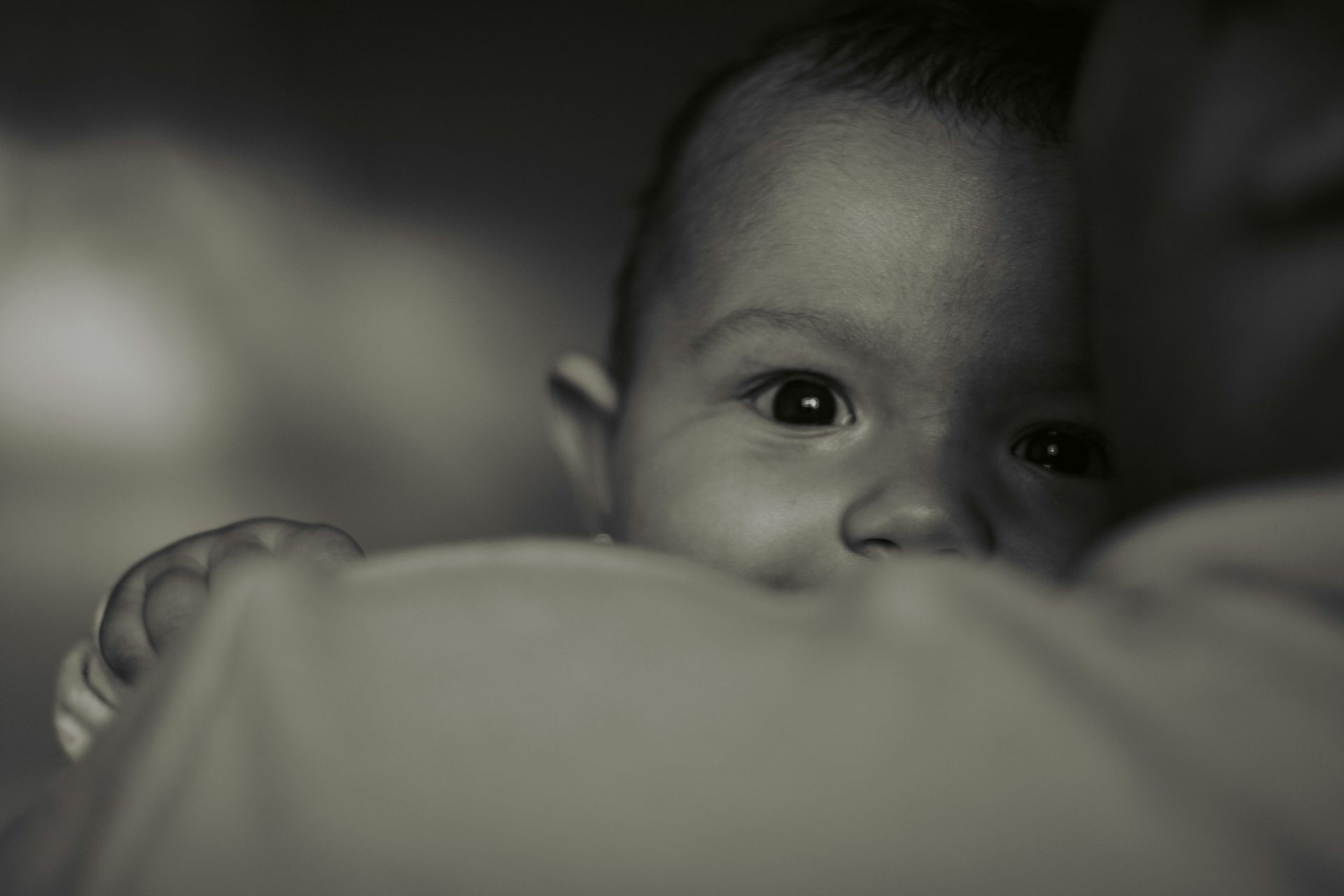
Inside the head of my three-month-old granddaughter, Lucy, said G.K. Chesterton is, "a new universe, as new as it was on the seventh day of creation...a new system of stars, new grass, new cities...and new seas." And this is because, he adds: The gravity of astonishment at the universe...dwells in the eyes of a baby three-months-old [and] the universe is put upon its trial and forces us actually to remodel our conduct...we seem to be dealing with a new race, only to be seen through a microscope...[with] delightful bulbous heads, three times too big for the body. But Chesterton's central thesis in this essay is not that babies are so marvelous, but that our treatment of each other as adults, in contrast, is so broken. "It is our attitude towards grown-up people that is wrong," he writes, because we no longer see each other with astonishment and wonder (unless, that is, we are falling in love). But babies remind us that humans really are astonishing, and this "revolutionary theory of the marvelousness of all things" should force us to "remodel our conduct" toward everyone we meet. A baby seems to be a necessary icon for us, correcting our eyesight which grows old and struggles to see "the weight of glory" in each other as teenagers, adults, and perhaps especially, as old people. Even though he did not reference icons in his essay, we seem to drift very easily into what could be called a type of iconoclasm, an inability to see each other as image bearers of God Himself. William Wordsworth describes us as "trailing clouds of glory" when we first arrive here "from God, who is our home." But soon, he says, "shades of the prison-house" begin to smother us, and we forget. "We bow to grown people," says Chesterton in this same essay, "take off our hats to them, refrain from contradicting them flatly, but we do not appreciate them properly." God speaks to us, like we are working through in St. John of Damascus , through the "cataphatic or apophatic spectrum of theology," or literally from the spoken word (cataphatic) or unspeakable word (apophatic). Apophatic I noticed has the same root in Greek as Infant does in Latin. Both mean "unspoken." God has given us both bibles and babies, speechless wonders through which He means to unglaze our eyes and fill us with astonishment. MARK C. WATNEY is professor emeritus at Sterling College, assisting in its newly established C. S. Lewis Center. He has given papers at Harvard's Center for Hellenic Studies and Dordt College
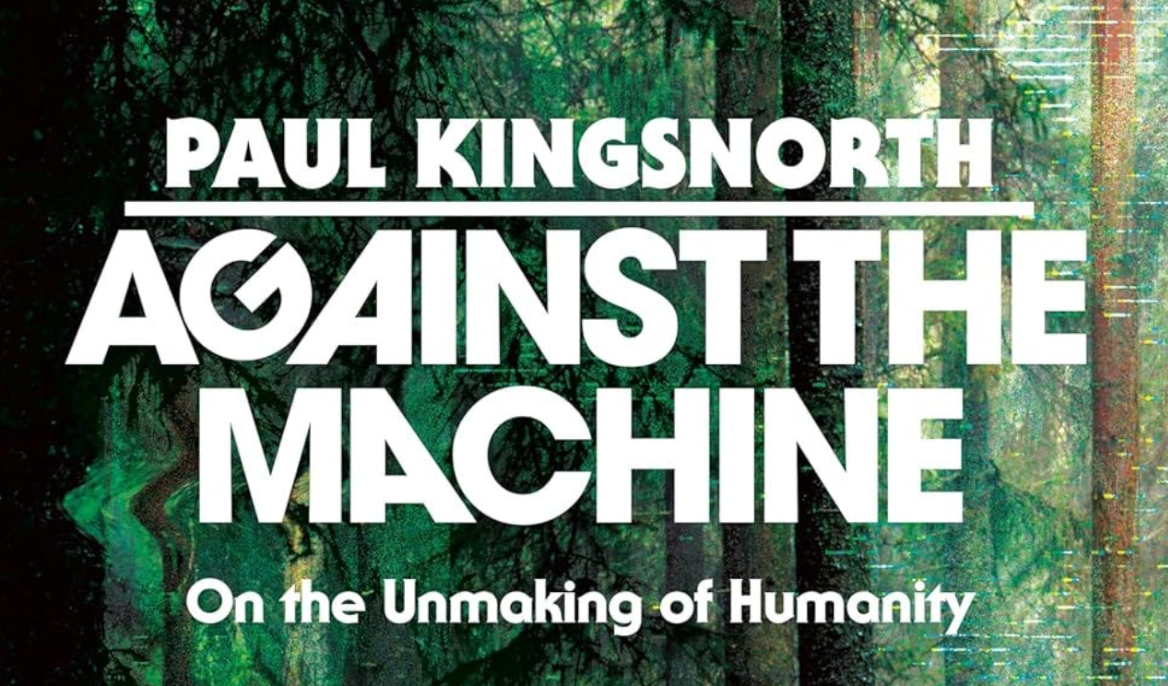
"God became man, so that man might become God." St. Athanasius the Great, On the Incarnation (54:3) These words from St. Athanasius may sound, at first blush, provocative. However, St. Athanasius is restating, perhaps more simply, what St. Peter says in his second epistle: the promise of being united to Christ is that men and women made in His image will partake in His divine nature (2 Peter 1:4). Paul Kingsnorth's latest book, Against the Machine, inverts this idea and opens our eyes to the world emerging at a rapid rate, the world dominated by what he calls The Machine. The new mantra of The Machine age is, instead, this: Man will become God by Man's own self-creation. Reading Kingsnorth is not for the faint of heart. It's easy to be overcome by despair. The goal of the Machine age is "transhumanism", to be liberated from the constraints of the body. For the transhumanist (self-described), the future is disembodied. The future is limitless. But this is not liberation. Because the Machine is not limited to the physical world, it follows naturally there is a spiritual nature to this lifestyle, what he ultimately identifies as a manisfestation and/or manipulation of the demonic. Whether or not you agree with his ultimate conclusion, we can see its effects. An entire generation, and many across generations, addicted to screens. Disintegration of communal life, most disastrously in the breakdown of the family. Increasing rates of loneliness, depression, and suicide, especially among children. It's clear we need a Savior, and the Machine isn't it. Instead, Kingsnorth encourages us toward a revival of community, men, women, and children living embodied lives in the same space and time: working together, eating together, worshipping together, loving each other, carrying each other's burdens. If this sounds like Eighth Day Institute...if this sounds like what the Church is meant to be, it is because this is exactly what the Church is. We are saved together in Christ. MICHAEL SIMMON currently serves as the Secretary of Eighth Day Institute Board of Directors and Coordinator for Hall of Men. He resides in Wichita, Kansas with his wife and four children.
"What is it that has ordered the things of heaven and those of earth, the things which move through the air and those which move in the water; nay, rather the things which proceeded them: heaven and earth and the natures of fire and water? What is it that combined and arranged them...set them into motion and put them on their unceasing and unhindered course?..But who is the architect of these things? Or did not he who made them also bring them into being? We shall certainly not attribute such power to spontaneity." On the Orthodox Faith, Chapter 3 This comes after St. John of Damascus sets out to delineate between the created and the uncreated, a fact which, while at the core of existence, seems for him to be, for this very reason, the simplest to believe. Everything but God is created and, thus, susceptible to change. This means people, but this also means demons, angels, the rest of the created order across the entire cosmos. Everything is vulnerable to unrest. Except for God. If you have ever tried to explain the Holy Trinity to a child for the first time, maybe you have felt as I have the weightier, inexpressible side of God's unchangeability: how do I possibly communicate this essential fact to the person in front of me? (This is usually when my faint stutter starts to pop up again.) I like that here, like St. Patrick reaching for a three-leaf clover, St. John brings us back to earth to better understand the cosmos. Fire and water are no less mysteries than heaven and earth. And yet here we are, cooking and washing, eating and drinking, filled and sustained on what we can neither fully explain nor claim to have created. Only God is unchanging. Vice versa, God is the only constant we need. Maybe the rest is better left unsaid. LUKE TAYLOR GILSTRAP is Vice President of the Board of Directors for Eighth Day Institute. His poems have appeared in Spiritus, Ekstasis (Christianity Today), and Relief Journal, among others. He lives happily in Wichita, Kansas with his wife and three sons.

"Now, one who would speak or hear about God should know beyond any doubt that in what concerns theology and the Incarnation not all things are inexpressible and not all are capable of expression, and neither are all things unknowable nor are they all knowable. That which can be known is one thing, whereas that which can be said is another, just as it is one thing to speak and another to know. Furthermore, many of those things about God which are not clearly perceived cannot be fittingly described, so that we are obliged to express in human terms things which transcend the human order. Thus, for example, in speaking about God we attribute to Him sleep, anger, indifference, hands and feet, and the like." On the Orthodox Faith, Chapter 2 When I was studying Fiction in graduate school, one of the first methods I learned to really situate the reader in the story you were about to tell them was disorientation; if you wanted to ground them in one story, first you had pull the rug out from under their feet. So it's fitting that in the beginning of St. John Damascene's On the Orthodox Faith, before rebuilding our foundation, he first puts us squarely in limbo, seesawing back and forth between certainty and uncertainty. To paraphrase, there is no doubt (certainty) that about God some things can be expressed...but not all things (uncertainty). Some things about God are truly knowable (certainty), but some are unknowable (uncertainty). Oh, and while we're speaking about God (certainty), let's admit there's a gap, too, between what we say and what we know (uncertainty). My favorite line in this spiraling excerpt, "...it is one thing to speak, and another to know," takes me back to the final lines in Wendell Berry's poem, "How to Be a Poet," which he wrote primarily as a reminder to himself: Accept what comes from silence. Make the best you can of it. Of the little words that come out of the silence, like prayers prayed back to the one who prays, make a poem that does not disturb the silence from which it came. Wherever your preferences fall on the cataphatic or apophatic spectrum of theology (whether you lean more toward what we can say about God or what we cannot), Berry's poem, I think, would nod along with St. John: before we say too much, let our words be preserved by the silence from which they came. I'm thinking of the silence, that filling, restorative quiet I feel when I step into a cathedral or in some of my favorite moments with my kids in the early hours. Even before praying, can we hear the One already praying in us? Let's start there. LUKE TAYLOR GILSTRAP is Vice President of the Board of Directors for Eighth Day Institute. His poems have appeared in Spiritus, Ekstasis (Christianity Today), and Relief Journal, among others. He lives happily in Wichita, Kansas with his wife and three sons.
Late-Night Bookstores and Spiritual Reading
On St. Benedict and the Making of Vows

The Pursuit of Truth in the Age of AI

On the Theology of Raising Chickens

G.K. Chesterton and Raising Small Children

"Seal of the Fathers"