Meeting of Our Lord, Hope and History, and Acedia
by Erin Doom
Feast of the Appearance of Christ to Saint Martin of Tours
Anno Domini 2021, February 13
1. Bible: Luke 2:22-40
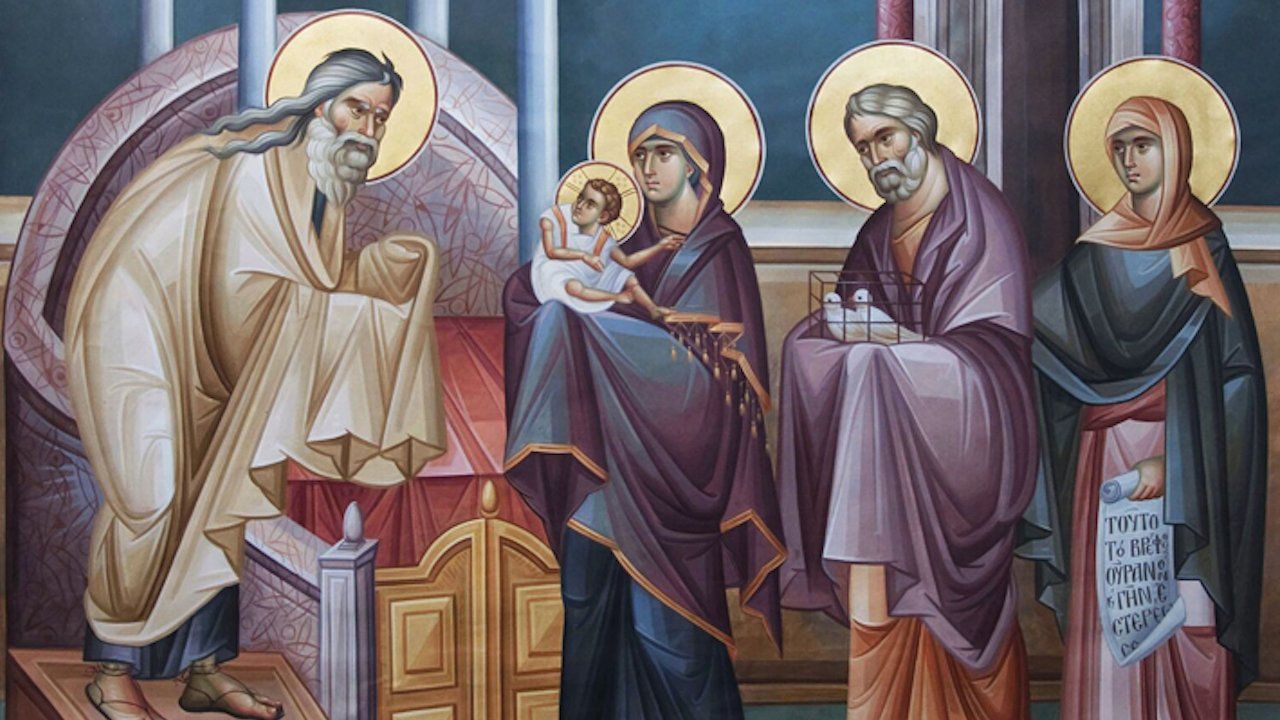
At that time, the parents brought the child Jesus up to Jerusalem to present him to the Lord (as it is written in the law of the Lord, “Every male that opens the womb shall be called holy to the Lord”) and to offer a sacrifice according to what is said in the law of the Lord, “a pair of turtle doves, or two young pigeons.” Now there was a man in Jerusalem, whose name was Symeon, and this man was righteous and devout, looking for the consolation of Israel, and the Holy Spirit was upon him. And it had been revealed to him by the Holy Spirit that he should not see death before he had seen the Lord's Christ. And inspired by the Spirit he came into the temple; and when the parents brought in the child Jesus, to do for him according to the custom of the law, he took him up in his arms and blessed God and said, “Lord, now let your servant depart in peace, according to your word; for my eyes have seen your salvation which you have prepared in the presence of all peoples, a light for revelation to the Gentiles, and for glory to your people Israel.”
And his father and his mother marveled at what was said about him; and Symeon blessed them and said to Mary his mother, “Behold, this child is set for the fall and rising of many in Israel, and for a sign that is spoken against (and a sword will pierce through your own soul also), that thoughts of many hearts may be revealed.” And there was a prophetess, Anna, the daughter of Phanuel, of the tribe of Asher; she was of a great age, having lived with her husband seven years from her virginity, and as a widow till she was eighty-four. She did not depart from the temple, worshiping with fasting and prayer night and day. And coming up at that very hour she gave thanks to God, and spoke of him to all who were looking for the redemption of Jerusalem. And when they had performed everything according to the law of the Lord, they returned into Galilee, to their own city, Nazareth. And the child grew and became strong, filled with wisdom; and the favor of God was upon him.
2. Liturgy: Feast of the Meeting of Our Lord and God and Savior Jesus Christ in the Temple
Last week, forty days after Christ’s nativity, the Church celebrated the Feast of His Presentation in the Temple (called the Meeting in the East because Christ met His people Israel in the persons of Prophet Simeon and Prophetess Anna; called Candlemas in West for custom of blessing candles). Here are two Orthodox hymns for the feast:
Apolytikion (First Tone): Hail Virgin Theotokos full of Grace, for Christ our God, the Sun of Righteousness, has dawned from you, granting light to those in darkness. And you, O Righteous Elder, rejoice, taking in Your arms, the Deliverance of our souls, who grants us Resurrection.
Kontakion (First Tone): Your birth sanctified a Virgin's womb and properly blessed the hands of Symeon. Having now come and saved us O Christ our God, give peace to your commonwealth in troubled times and strengthen those in authority, whom you love, as only the loving one
3. Fathers: “Homily on the Meeting of Our Lord and God and Savior Jesus Christ in the Temple” by St. Gregory Palamas
And here’s a sampling of the opening of St Gregory Palamas’s homily for this feast day:
After the Savior was born of the Virgin and was circumcised on the eighth day according to the law, then, as Luke the evangelist says, “when the days of their purification according to the law of Moses were accomplished, they brought Him to Jerusalem to present Him to the Lord; as it is written in the law of the Lord” (Lk. 2:22). He is circumcised according to the law, brought to Jerusalem according to the law, presented to the Lord as it is written in the law and a sacrifice is offered as the law demands.
Notice that the Creator and Lord of the law is completely obedient to the law. What does He achieve by this? He makes our nature obedient in all things to the Father, He completely heals us of its disobedience and transforms the curse on it into a blessing. As all human nature was in Adam, so it is in Christ. All who received their being from the earthly Adam have returned to the earth and been brought down, alas, to Hades. But, according to the apostle, through the heavenly Adam we have all been called up to heaven and made worthy of its glory and grace.
Read the full passage here.
4. Poetry: “Ceremonies for Candlemas Eve” by Robert Herrick
And here’s a poem for last week's feast from the 17th century English poet Robert Herrick.
5. Books & Culture: “Avoiding the Delimiting of Hope” by Casey Chalk
In a previous issue I referred to the Catholic philosopher Josef Pieper as "The philosopher of hope." In this review essay, Chalk reflects on Pieper’s small book
Hope and History, recently republished by Cluny Media. Here’s a bit from early in the essay:
Pieper observes, “no man can keep from hoping.” But what is hope? Pieper identifies a number of attributes of hope. In hoping, we expect what is good for us; we exude confidence and joyous expectation. Yet hope is complicated. Counter-intuitively, the most authentic hope appears precisely when lesser, more ephemeral hopes—perhaps in sensual pleasure, professional success, or even our own health—have been frustrated. Disappointment opens the way for the “purging of all illusory hopes”; “out of the loss of common, everyday hope true hope arises,” notes Pieper, citing German scientist Herbert Plügge.
Read the entire review essay here.
6. Essays et al: “Prophecy, Apocalyptics, and the End of History” by Josef Pieper
If Chalk didn’t persuade you to read
Hope and History, hopefully Pieper will. I’ve assembled three excerpts (two short and one long) on prophecy, apocalyptics, the end of history, all from the fifth and final chapter. Here’s a small sample in which you’ll not only learn about the Greek word
synaxis, but also
synousia:
Christians are convinced that the boundary of death separating this world and the next has, in a certain sense, already been crossed from the farther side, namely, through the event that is covered by the technical theological term “Incarnation.” One of the recurrent symbols through which men have, from time immemorial, attempted to make comprehensible the essential nature of what they hope for is the Great Banquet. Plato also refers to this, and that aspect of his thought should not, I believe, be forgotten. He speaks not only of a dwelling together, of a synousia (Phaedo, III b 7), of gods and men, but also expressly of a banquet in which the soul, outside of time and in a place beyond the heavens, takes part, as a tablemate of the gods, in satiating itself with contemplation of true being (Phaedrus, 247 a-e). This could not be expressed much better even by Christians, and their expression of it is, after all, not essentially different. But Plato would never have been able to dream of the communal banquet in which Christianity recognizes and celebrates the real beginning and pledge of that blessed life at God’s table. Since earliest times, it has been called synaxis, or communio. This implies, however, that one fundamentally misunderstands and degrades this table community if it is not conceived and enacted as a community of persons with one another, and indeed, a community from which nobody can be excluded through arbitrarily drawn restrictions.
Read all three excerpts here.
7. Essays et al: “The Sorrow of the World” by Francis Paget
This past week I’ve been researching and reading up on the demon (or thought/logismos or vice) of acedia. And I’ve discovered some real jewels, including a couple pieces by the nineteenth century English theologian and 33rd Bishop of Oxford. This one was a homily on 2 Cor. 7:10, “The sorrow of the world worketh death.” Here’s an early paragraph:
"The sorrow of the world." No discipline or chastening of the soul; no grief that looks towards God, or gropes after His Presence in the mystery of pain; no anguish that even through the darkness aye, even, it may be, through the passing storms of bitterness and impatience He can use and sanctify, for the deepening of character, the softening of strength, the growth of light and peace. No, none of these; but a sorrow that is only of this world, that hangs in the low and misty air, a willful sorrow that men make or cherish for themselves, being, as Shakespeare says, "as sad as night only for wantonness" (King John, IV. i 15). This is, surely, the inner character of "the sorrow of the world." This makes its essential contrast with the sorrow that could be Divine; the sorrow that Christ shared and knows and blesses; the grief with which He was acquainted. This is the sorrow that worketh death; the sorrow that the great poet of the things unseen [i.e., Dante] sets close by anger. Let us try to think about it for a little while.
N.B. Paget also published a long introductory essay on acedia at the beginning of his published homilies (The Spirit of Discipline) which will be included in the digital Symposium Library.
8. Essays et al: “Accidie” by Aldous Huxley
This one was one of the most surprising and delightful finds by none other than the author of Brave New World. His opening description sounds like something straight out of Evagrius or Cassian:
The coenobites of the Thebaid were subjected to the assaults of many demons. Most of these evil spirits came furtively with the coming of night. But there was one, a fiend of deadly subtlety, who was not afraid to walk by day. The holy men of the desert called him the dæmon meridianus; for his favorite hour of visitation was in the heat of the day. He would lie in wait for monks grown weary with working in the oppressive heat, seizing a moment of weakness to force an entrance into their hearts. And once installed there, what havoc he wrought! For suddenly it would seem to the poor victim that the day was intolerably long and life desolatingly empty. He would go to the door of his cell and look up at the sun and ask himself if a new Joshua had arrested it midway up the heavens. Then he would go back into the shade and wonder what good he was doing in that cell or if there was any object in existence. Then he would look at the sun again and find it indubitably stationary, and the hour of the communal repast of the evening as remote as ever. And he would go back to his meditations, to sink, sink through disgust and lassitude into the black depths of despair and hopeless unbelief. When that happened the demon smiled and took his departure, conscious that he had done a good morning’s work.
And then, at the end, Huxley offers a masterful explanation of acedia’s shift from being a sin to being a respectable emotion to being a widespread malaise. You can read the whole thing, along with that conclusion here.
Share this Post on Your Preferred Platform