Myrrh-streaming, Christ-cleansing, Alexandria, and David Jones
by Erin Doom
Feast of the Holy, Glorious Demetrius the Myrrh-streamer of Thessalonica
Anno Domini 2020, October 26
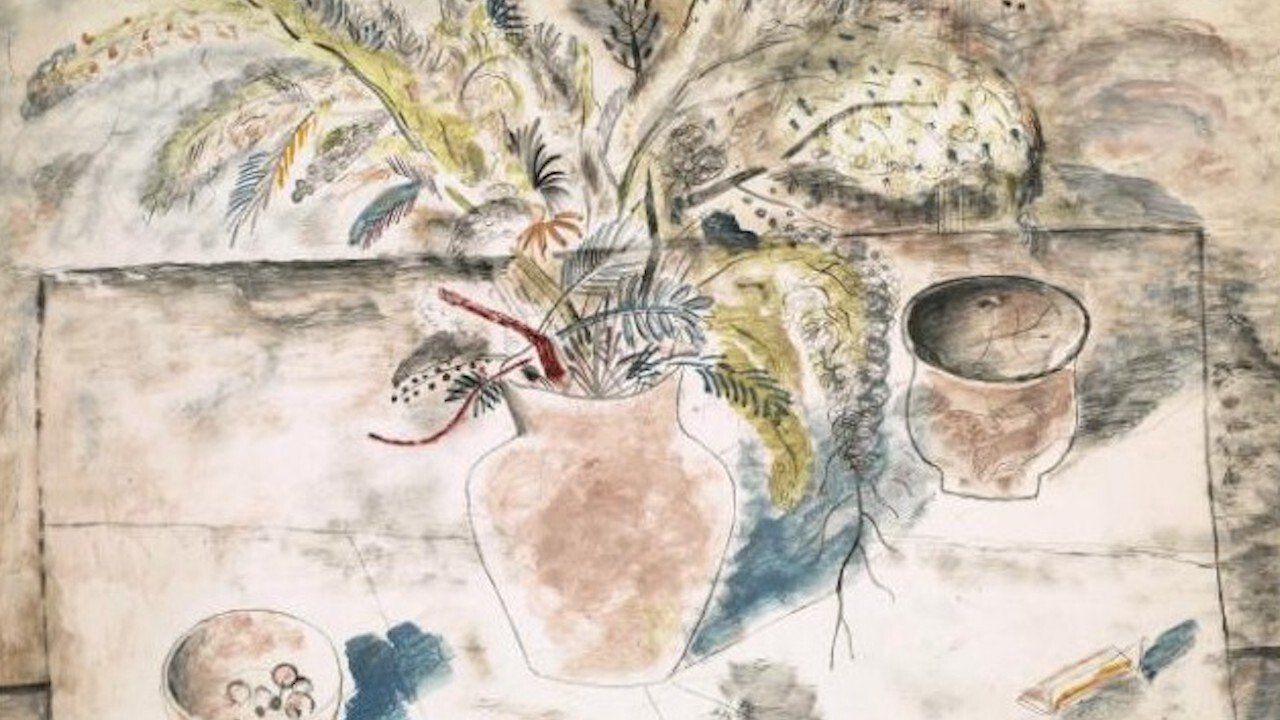
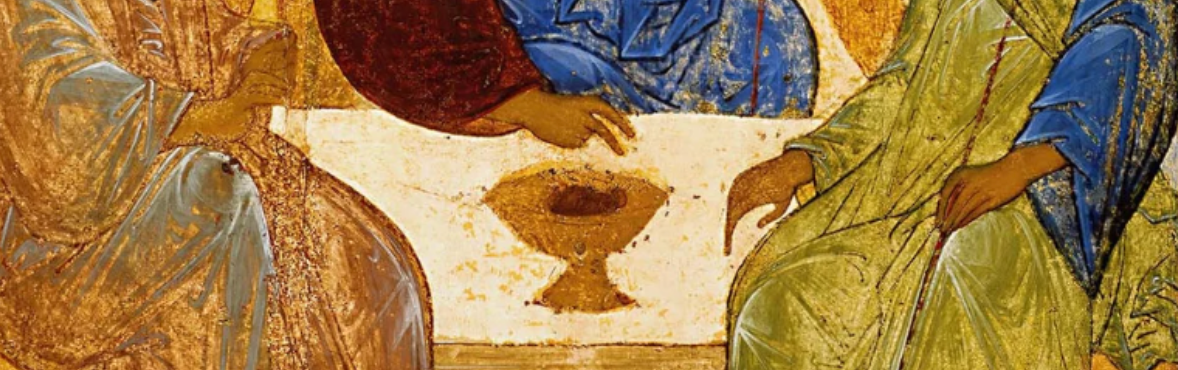
The Table Top by David Jones (1928)
1. Bible
Sunday – Feast of St Tabitha who was raised from the dead by Peter the Apostle: Gal. 1:11-19. Lk. 8:26-39. Online here.
Monday – Feast of the Holy Great Martyr Demetrius the Myrrh-streamer: 2 Tim. 2:1-10. Jn. 15:17-27; 16:1-2. Online here.
Tuesday – Feast of St Procla the Wife of Pontius Pilate: Col. 1:1-3, 7-11. Lk. 11:1-10. Online here.
Wednesday – Feast of the Holy Protection of the Theotokos: Heb. 9:1-7. Lk. 10:38-42, 11:27-28. Online here.
2. Liturgy: Feast of St Demetrius the Myrrh-streamer
Today the Orthodox Church commemorates St. Demetrius the Myrrh-streamer of Thessalonica. You can read the fascinating story of his life here (his parents were secretly Christians, he was raised in a secret church in his parents’ home, he was later called a “second Apostle Paul,” and his relics have been wonder-working ever since his martyrdom).
Here are the hymns for his feast day:
Apolytikion – Third Tone: The world has found in you a great champion in time of peril, as you emerged the victor in routing the barbarians. For as you brought to naught the boasts of Lyaios, imparting courage to Nestor in the stadium, in like manner, holy one, great Martyr Demetrius, invoke Christ God for us, that He may grant us His great mercy.
Kontakion – Second Tone: God, who gave you invincible power and with care kept your city invulnerable, royally clothed the Church in purple with the streams of your blood, for you are her strength, O Demetrius.
3. Fathers: “Christ Teaches Us How to Be Cleansed” by St Dorotheus of Gaza
The sixth-century hermit St Dorotheus has long been a hero of mine. His commentary on the Paschal hymn of St Gregory the Theologian was the first issue of the print edition of the Patristic Word that we published back in 2013. Here’s a sample from today’s passage, excerpted from his treatise “On Renunciation”:
Was man not created in all comfort, in all joy, in perfect peace and in all glory? Was he not in paradise? He was sent away. Why? God said you shall not do this, and he did do it! Do you not see the pride in that, the obstinacy, the insubordination? And so God said, the man is mad; he does not know how to be happy, unless he experiences evil days he will go away and completely perish. Unless he knows what tribulation is he will never know what rest is. He then gave him what he deserved and expelled him from paradise. Then He delivered him to his own self-will and to his own desires, that he may grind down his own bones and learn that he cannot go straight on his own, but only by the command of God; so that learning the poverty of disobedience may teach him the tranquility that comes from obedience. As the prophet says, “Your rebellion shall teach you” (Jer. 2:19). Nevertheless, the goodness of God, as I have said many times, did not despise what He had formed, but again urged him to obey, again exhorted him. “Come to me,” He said, “all you who labor and are heavily burdened and I will refresh you” (Matt. 11:28)—as much as to say, “See how you have to work! See the misery you have brought on yourself! See how you are tried by evil and your own unruliness! But come change your ways, acknowledge your own powerlessness so that you can come to your rest and your own true glory.
4. Poetry: “A, a, a, Domine Deus” by David Jones
Here is the first half of a short and remarkable poem by the Welsh poet and artist David Jones, the focus of Fr. Gabriel’s 2020 Inklings Lecture:
I said, Ah! what shall I write?
I enquired up and down.
(He’s tricked me before
with his manifold lurking-places.)
I looked for His symbol at the door.
I have looked for a long while
at the textures and contours.
I have run a hand over the trivial intersections.
I have journeyed among the dead forms
causation projects from pillar to pylon.
I have tired the eyes of the mind
regarding the colors and lights.
I have felt for His Wounds
in nozzles and containers.
5. Books & Culture: “Paul Kingsnorth’s Alexandria” by Rod Dreher
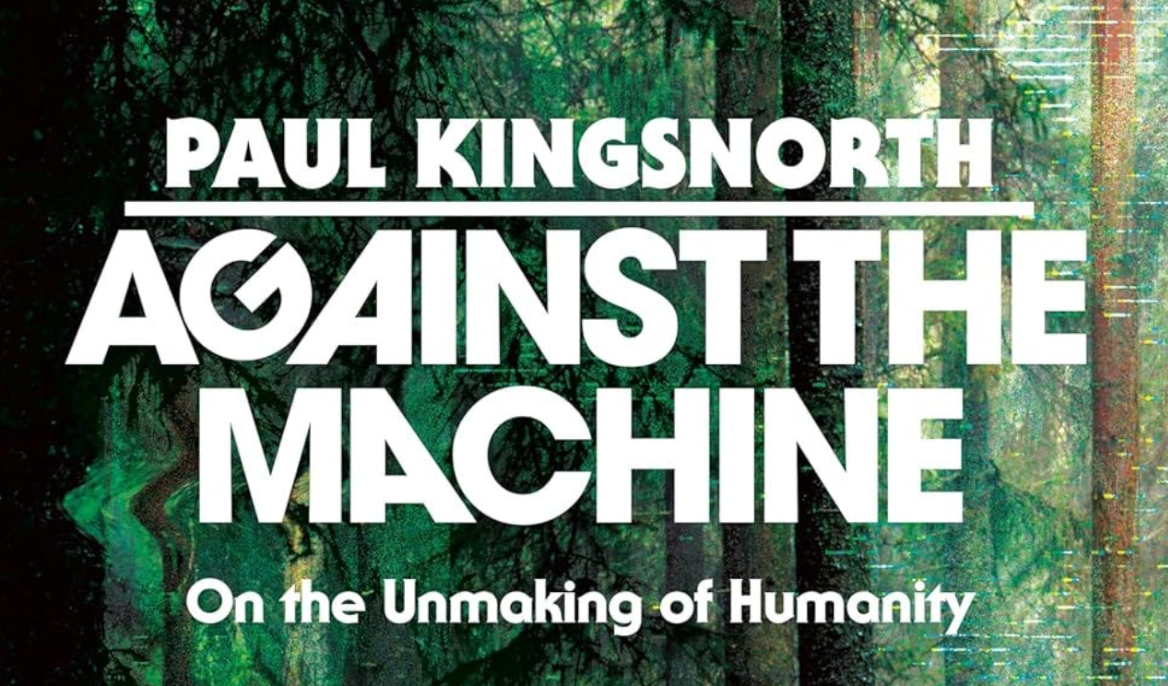
Thematically, this one is a bit off the beaten path for this issue. But this interview with Kingsnorth is remarkable and I can’t help myself. I first discovered Kingsnorth through another piece by Dreher on Kingsnorth’s short story “The Basilisk.” It’s a (frightening) fictional exchange of letters that reflects on the impact of internet technology. If you haven’t read it, PLEASE read it—and read it to your kids—here. In this more recent piece by Dreher, he interviews Kingsnorth about his new novel Alexandria (the third in a trilogy). It’s a great interview and you should read the whole thing here. For me, this was the most remarkable part—Kingsnorth responding to Dreher’s question about his personal religious practice:
I have been on an increasingly intense spiritual search for a decade, which has taken me through a long immersion in Zen Buddhism, and more recently through various forays into neo-paganism, mythology, gnosticism—you name it. Actually I think my search for some kind of objective truth goes back perhaps even to childhood. My love of nature and my desire to protect it was in many ways driven by what I think now was a religious sensibility—as I wrote in this essay a few years back.
But something was missing from all of this. It turns out that something was God. And 2020, in that respect, has been a revelation to me—literally. I found myself being dragged kicking and screaming earlier this year towards the one place I never thought to look: which is to say, to my own ancestral faith, Christianity. This is a journey that has come upon me entirely by surprise, and it’s only just beginning, so I’m not going to try and lock it down with words, or even pretend that I really understand what’s happening. But something big is going on, and it’s not my doing. I’ll just say that the world has taken on a completely new shape, and I’m still gaping at it. One day I might try and write it down.
Read the whole interview here.
6. Essays et al: “David Jones: History & Sacrament as Home” by Fr. Gabriel Rochelle
Earlier this week in
Microsynaxis, I offered a teaser to Fr. Gabriel’s 2020 Inklings Lecture on David Jones.
You can read the whole thing here. The video of the lecture (and follow-up seminar) will be added to the Digital Library by next weekend’s issue of
Synaxis.
7. Essays et al: “A Civilized Town as Place of Pilgrimage” by David Jones
Since David Jones is so unknown—unjustly so—this piece and the next one (as well as the poem included above) provide you an opportunity to acquaint yourself with him. In addition to nicely complementing the recent Inklings Festival theme of “oikophilia,” this piece also speaks powerfully to my own personal experience this past week staying in a small rural New Mexican village. Like everywhere else in America (and elsewhere in the world), despite its small size and its rural geographical location in the middle of nowhere, Jones’s conclusion seems to apply: “Probably the rising tide cannot be turned back.” At least not immediately. But… might there be hope to over the long haul to redeem it, to renew it and make it a holy place, a place of pilgrimage? I believe so. I hope you’ll be inspired like me by reading this short introduction to a longer essay by Jones here.
8: Essays et al: “David Jones” by Eric Gill
Eric Gill knew David Jones extremely well. So if you want to know Jones, you’d do well to listen to Gill. According to Gill,
Mr. David Jones is a painter who sees this modern dilemma very clearly, and we should miss all the quality of his work if we did not see that it is a combination of two enthusiasms, that of the man who is enamored of the spiritual world and at the same time as much enamored of the material body in which he must clothe his vision.
If you want to learn more about Jones and his art, read the whole thing here.
Share this Post on Your Preferred Platform