The Monster Behind the Massacres
by Fr Paul O'Callaghan
Feast of St Mary Magdalene, the Holy Myrrh-bearer and Equal to the Apostles
Anno Domini 2022, July 22
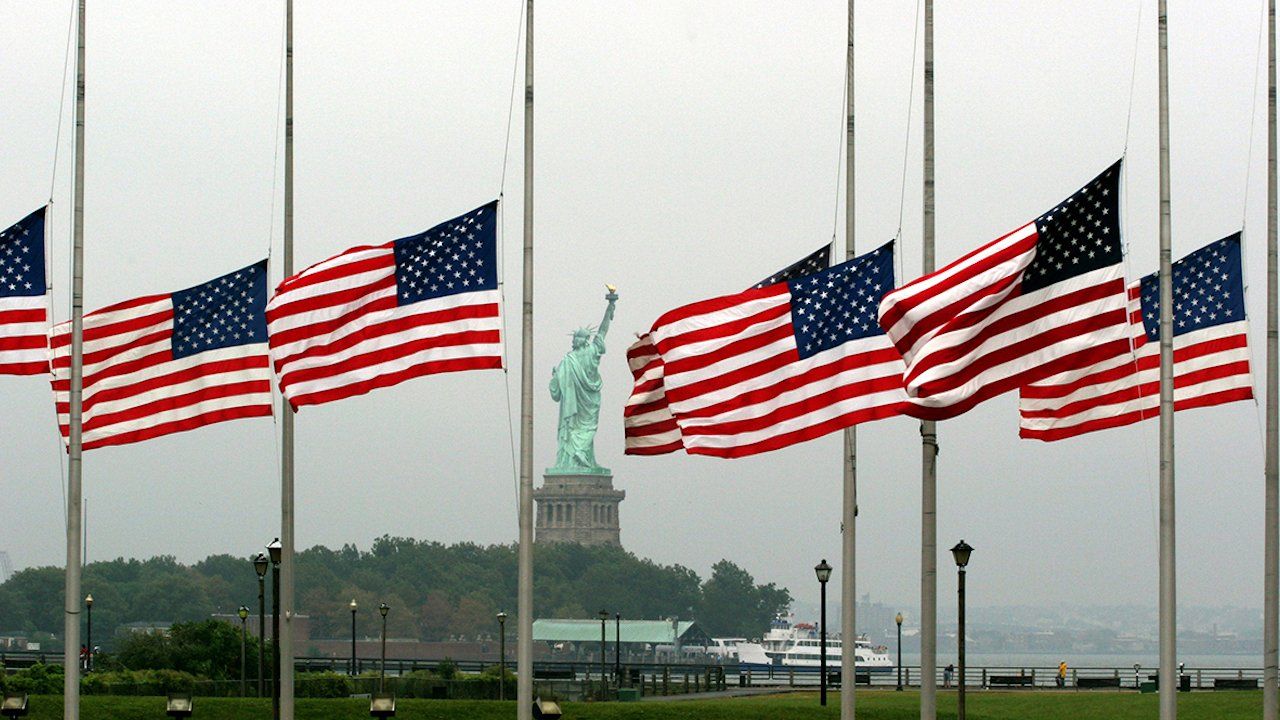
I’ll begin with a personal observation. I’ve noticed in recent months that public flags seem to be at half-mast almost all the time. I wonder at times what loss or tragedy is being mourned. “What is it now?” Sometimes I can’t come up with the answer. But of course, during the week of May 25, 2022, there was no reason to wonder. The same is true of the week that followed the Highland Park massacre.
When I was a child, flags flying at half-mast were rare and noteworthy. What is different between then and now? What has changed? Why are we seeing one mass shooting after another in recent years?
In a press conference following the tragic Uvalde massacre, Texas Gov. Gregg Abbott observed that for 60 years in Texas, 18-year-olds have been able to legally purchase guns. Back then mass school shootings were unheard of. What has changed?
In my college town of Chico, CA—a small, semi-rural community back in the 1970’s—many of the local high school boys had rifle racks in the back of their pickups. They would leave them parked with their rifles racked up in plain view. No one thought anything of it. There were no school shootings. What is different between then and now? What has changed?
We must look deeply into the question of why this is happening—over and over again—innocent kids and their brave teachers, among others, being slaughtered.
Ramsha Afridi writes, “… (I)n my view, people are now looking for simple solutions to a problem which likely has more complicated answers. Not many have acknowledged that perhaps such tragedies are in part due to problems much deeper rooted in modern-day America” (https://www.revolver.news/2022/06/uvalde-texas-school-shooting-existential-crisis-society-salvador-ramos/ All Afridi quotations are from this article).
There is no single answer that explains it all. But I think we can identify several factors that play into it. And they are spiritual and moral.
In chapter 9 of the gospel of John, we find Jesus saying, “‘For judgment I have come into this world, that those who do not see may see, and that those who see may be made blind.’ Then some of the Pharisees who were with Him heard these words, and said to Him, ‘Are we blind also?’ Jesus said to them, ‘If you were blind, you would have no sin; but now you say, “We see.” Therefore your sin remains’” (vv. 39-41).
I propose that we have become blind to ourselves. We have forgotten who we are. We—meaning the popular American mindset—have lost sight of ourselves. How did this transpire?
For decades now in America, messaging —from the media, from Hollywood, in advertising, and in pop psychology—has been to “follow your passions,” “express yourself,” “indulge your appetites,” “fulfill your fantasies,” “do what you feel.” In pop psychology, to do so is called “being authentic.”
“Being authentic” means one ought freely express and indulge his impulses, desires, and appetites. Doing so is to be true to oneself and failing to do so is to be false to oneself—it is to be “inauthentic.” Thus controversial transexual swimmer Lia Thomas expressed it well in the context of athletics: “Trans people don’t transition for athletics. We transition to be happy and authentic and our true selves” (Western Journal, June 8 2022). One’s “true self” is what one feels. If a man feels like a woman, then he IS a woman.
Some readers may be old enough to remember the Bob Newhart Show, a 1970’s sitcom. Bob played a psychotherapist who ran group therapy sessions. One of the premises of these session was that the participants had to be authentic. This meant that everyone in the group had to express exactly what they thought of the others, no matter how rude or offensive it might be to them. In the show, this led to many funny moments. As a relationship strategy, it is disastrous. Yet the show portrayed a developing trend in psychotherapy that presaged a growing cultural shift toward the non-moralistic validation of the self.
Thus in the time since, many modern Americans have come to live by no other standard than their own individual feelings, impulses, and desires. The general acceptance of the “authenticity” principle has led to a pervasive narcissism in American popular culture. Individual self-expression has become an overriding moral value.
This is what lies behind the current trend in outrageous grooming, clothing, accessorizing, and body art. By these means, a person proclaims his true identity to the world. One’s natural appearance is only raw material to be reconfigured by artificial means into an act of expressiveness. In a fresh twist of existentialism, people have come to believe they are their own creations. On top of this, social media entices users to become exhibitionists, displaying their self-creations to the world. What belongs to the self is inherently valuable and is to be asserted with pride.
During the 21st century, this trend has become most significant in the arena of sexuality. In fact, popular media advocates forming one’s identity around sexual passions. Pick your preferred letter from the alphabet soup, hang it on a placard around your neck, and proclaim to the world that you are your sexual proclivities. We have heard it multiple times over: “This is who I am.” Your sexual desires constitute your identity.
The notion that human beings are to be defined solely by individual subjective criteria, i.e., feelings and desires—and most notably by sexuality—leads to innumerable absurdities and travesties. Ben Shapiro comments at length:
This perspective is absolutely incoherent. Ironically, this incoherence is exposed by the conflict between the different letters within the alphabet soup of the supposedly sexually marginalized. The case for tolerance of lesbian and gay Americans used to be that biological drives should not be regulated by society at large, because such drives were inborn and innate; that idea at least had the merit of internal consistency.
Now, however, that idea has been jettisoned for its logical opposite, the belief that biology has no hold on us whatsoever, and that we ought to be free to define ourselves in opposition to our own biology, changing our gender and sexual orientation at will (i.e., on the basis of our feelings).
… And yet here we are, told … that we must ignore the internal contradictions of left-wing sexual ideology, and simply pretend the incoherence away. We are told that we ought to stand for women’s rights by the same people who insist that Lia Thomas is a woman; we are told that one need not be a biological female to be a lesbian; we are told that biology dictates behavior, but that biology must never be used as an identifier.
None of this makes one whit of sense. But we ought to be proud of it, because after all, it liberates us to celebrate our inner sense of authenticity, free of society’s strictures. (Ben Shapiro, The Daily Signal, June 1)
Such an untethered subjectivism is mind-boggling. From an Orthodox Christian anthropology, it incorporates the most egregious error imaginable. Nothing could be further from the mind of Christ, the Apostles and Fathers. In Orthodoxy Christianity, we call such desires “passions.” Fallen creatures that we are, our passions are inherently disordered. They are forces active within us, but they are NOT who we are. They are hardly the seat of our identity. A person is so much more than his passions.
Who are we? What is our fundamental identity? Human beings are creatures made in the image of God; we are called to grow into the actual likeness to God by communion with Him and the cultivation of godliness. The Apostle Paul denotes Christians as adopted sons and daughters of God. The Christian calling is to purify our persons from the operations of the passions, not to indulge them, that we may become “partakers of the divine nature” (cf. 2 Peter 1:4). “And those who are Christ’s have crucified the flesh with its passions and desires” (Gal. 5:24). “Beloved, now we are children of God; and it has not yet been revealed what we shall be, but we know that when He is revealed, we shall be like Him, for we shall see Him as He is. And everyone who has this hope in Him purifies himself, just as He is pure” (1 John 3:2-4).
It should be noted that popular acceptance of the notion of authenticity is hardly limited to matters of sexuality. It is pervasive. Think back to the riots that characterized the summer of 2020. We all observed the burning, looting, destruction, violence, and larceny. Yet many in the media were quick to justify it. How? The destructiveness was a legitimate expression of rage on the part of oppressed people. The rioters were expressing their feelings. They were being authentic. How could they possibly be condemned? Of course, little concern was expressed for property owners and those who had been assaulted by rioters.
A noteworthy effect of this psychology of authenticity on the general population has been a lack of impulse control. We have been conditioned to obey our impulses. “If it feels good, do it!” is the mantra. Yet as the media relentlessly promotes self-indulgence of every kind, at the same time they preach and fret to us about “unhealthy lifestyles,” the “obesity epidemic,” the “opioid crisis,” AIDS and STDs, and the explosion of violence, all of which are directly related to what they continually promote: the unbridled indulgence of the passions.
The message has not been lost on the socially marginalized and emotionally damaged. Thus, if you’re boiling with rage because your grandmother won’t let you do what you want, or because your mom is too busy with her boyfriend, if you’re filled with loathing at yourself, at life, and everything in this world, then of course, you too have the right to be authentic and to express your feelings. You should act out your rage. So you decide to take yourself out and a lot of innocent people with you. “They are going to have to pay for my pain,” as in the case of the Tulsa shooter who murdered his surgeon and several others because his back was hurting badly after surgery.
Living as we do in a culture charged with adherence to authenticity and self-expression, we have forgotten the once universally acknowledged truth: good character and virtue can only be built on the foundation of self-restraint. But in popular culture, self-restraint is considered “repression.” Thus, we’re told that if one represses passions and desires, he becomes unhappy, anxious, unstable, and neurotic. Yet in fact the opposite is true. The person who has achieved self-mastery is the happiest person in the world. We call many such people saints.
With overwhelming success, media, academic, and political elites have promoted a godless philosophy that has caused us to become blind to who we are—creatures created in the image of God, called to grow into His actual likeness. As a result, we have exchanged our divine destiny for a “mess of pottage,” choosing to identify ourselves with the passions of the flesh and reveling in them. Is it any wonder that we behold rational society unraveling all around us?
In the Revelation to John, Jesus says: “You say, ‘I am rich, have become wealthy, and have need of nothing’—and do not know that you are wretched, miserable, poor, blind, and naked” (Rev. 3:14). Do not these words apply to modern America?
Ramsha Afridi comments: “The truth is that the growing complexities in modern day America are dismantling the cultural foundations of what its society was once built upon. It is undeniable that American culture is in decay.”
A fundamental reason for this is that American popular culture has become blind to God and His Law. In our passionate pursuit of pleasure, we have attained the lot of all hedonists: we have lost our moral compass.
What does a moral compass indicate? That which is right and that which is wrong. What is the name of that compass? God’s law. Like any compass, it is precisely directive: for example, Thou shalt not steal; Thou shalt not commit adultery; Thou shalt not kill.
Such commandments are absolutes, and when properly understood and nuanced, they are true for everybody everywhere. This is called objective morality.
Yet this compass was tossed out a long time ago in our post-Christian media, academic, and political culture. What was it replaced with? Subjective morality. What is right or wrong is what you feel is right or wrong. There is no absolute moral law to which we all are bound. In addition, many Americans have jettisoned belief in God’s judgment and the danger of hell. For them, then, there are no ultimate consequences for their actions—even if it is the random murder of innocents.
Is there a great moral gap between dismemberment abortions, partial birth abortion, and infanticide? Between infanticide and outright murder? If there is a right to kill your preborn child, what does that tell us about the value of human life in general?
Rep. Billy Long, a Missouri Congressman, says the killing of 63 million babies in abortions has destroyed the respect for human life that existed prior to Roe v. Wade. Long told the the Missouri-based radio station The Eagle 93.9 that guns aren’t the issue. He criticized proponents of gun control for “trying to blame an inanimate object for all of these tragedies.”
“When I was growing up in Springfield, you had one or two murders a year,” said Long, who is running for the U.S. Senate. “Now we have two, three, four a week in Springfield, Missouri. So something has happened to our society,” he continued. “I go back to abortion, when we decided it was OK to murder kids in their mothers’ wombs. Life has no value to a lot of these folks.”
There is a direct link from one to the other. It is called the culture of death. Whether one human being lives or dies is entirely dependent upon the choice of another who has the power to kill. This is what it means to be “pro-choice.” “I have the right to choose whether or not to kill an innocent human being.” Thus we see that option being foisted upon the innocent every day, whether inside or outside the womb.
After the Uvalde tragedy, media pundits were quick to cry out for more government programs for the mentally ill as a preventative to such incidents. Yet there is no hard evidence that Salvador Ramos suffered from mental illness. In the therapeutic society, it is often assumed that anyone who would commit such a crime must be mentally ill. Yet such an assumption fails to distinguish mental illness from moral illness.
At the root of this moral illness is the massive Love Deficit that pervades American society. An Evangelical minister once told me, “Peace means knowing that you are loved.” Yet today, far too many Americans have no peace, because they have known little to no love. Having grown up surrounded by narcissistic individuals—in many cases their parents—their emotional and ethical growth has been tragically stunted. Those who are unloved are incapable of giving love.
Jeremy Cahnmann, who coached Highland-Park shooter Robert Crimo III in an afterschool sports program at Lincoln Elementary School, recalled the following: "I remember the parents more than him because they were kind of a problem. There wasn't a lot of love in that family." A neighbor of Crimo echoed Cahnmann’s observation: "The signs were there for a long time. There were always police cars at the house. The parents were arguing, fighting all the time.”
Allie Beth Stuckey commented, “There is nothing more dangerous than a man with nothing to do and no one to live for. This has been true in every place for all of time. Our young men are drowning in idleness, purposelessness, and godlessness, and we’re paying for it.”
Thus, an ever-increasing number of Americans are random isolated individuals searching for an identity, often full of anger and self-loathing, perhaps having given up on the hope of ever being valued and loved. This is why see so many examples of bizarre forms of grooming and dressing today. Many young people are desperately grasping to create an identity for themselves, an overwhelming existential burden for those not granted one out of a nexus of loving relationships. This is why there is a current trend for young people to identify as “gay” or “trans.” Adopting such a label gives them a similitude of an identity.
Many isolated individuals have lost all connection to parents, siblings and other relatives—in some cases, to anyone at all. “Elder orphans,” who have no relatives or loved ones, now increasingly populate nursing homes. We see our streets filled with abandoned human beings camping on sidewalks in cities far from their places of origin, with no relationships except to the other addicts and mentally ill with whom they congregate.
Ramsha Afridi writes, and I quote at length:
This shift from an established family structure to a more atomized way of living is now an unavoidable part of life for many young people. Various studies have consistently revealed consequences manifesting in the most devastating ways.
Generation Z, despite being born in an era of technological and social advancement, is the loneliest generation in history. Up to a staggering 56% of generation Z have stated they have felt lonely multiple times during their childhood, according to the Pew Research Center.
Therefore it’s no surprise that Generation Z is also the most depressed. According to the APA’s 2020 Stress in America Survey, Generation Z were most likely to report signs of depression and psychological distress.
This means that more than ever, there is an immense lack of stable familial and community support in American society for which Generation Z seems to be paying a heavy price by being the age group most likely to have been brought up in a single-parent setting compared to previous generations.
According to evolutionary psychologists this malady of loneliness felt in childhood is reported known to follow through to adulthood, where such individuals are likely to report feeling more socially disconnected and alienated than those who did not report feeling lonely as children.
Humans are social creatures, and we have an evolutionary imperative to connect and function in accordance with a solidarity that stretches back for as long as Homo Sapiens have existed as a species.
Since time immemorial, we humans have hunted, farmed, and established social cohesion as a way of averting threats and looking after one another. This biological imprint has not vanished, establishing a social order without community spirit has negative foreseen and unforeseen consequences.
In contrast, the culture of individualism is touted by both the American Right and the Left. The Right typically valorizes “rugged individualism” in which each person must be free to achieve his own goals, visions, and dreams without interference from others, and if he fails the consequences are entirely his own. The Left emphasizes the necessity of a governmental social safety net that sets individuals free from providing for basic necessities in order to pursue personal goals, dreams, and visions. The general social impact trends toward a narcissistic individualism that sees all things in relation to self and an incapacity for true consideration for others.
Narcissistic individualism has given us a generation of human beings the likes of which has never been seen on the face of the earth. Afridi continues, “Ultimately, the new age culture of individualism is manifesting in young people who have no sense of purpose nor core values—only the latest technology, television program, or consumer product to worship or yearn for.”
Afridi continues:
Nearly one quarter of American children now reside in a single-parent living arrangement. It seemed that the Texas school shooter, Salvador Ramos, was one of such children. He did not reside with his father; in fact, he had not met his father since the pandemic began in 2020.
It appears Salvador Ramos may have also felt he lacked an adequate amount of love, care, and support. His father, after speaking to the Daily Beast, revealed: “My mom tells me he probably would have shot me too because he would always say I didn’t love him.”
Evolutionary considerations aside, her point is incontestable: the natural way of raising children is in a network of relations consisting of parents, grandparents, aunts, uncles, cousins, friends, and other community members. In such a setting, one’s identity as a member of the clan is a given, as one is inculcated in the history, traditions, values, origin stories, and transcendental orientation of the group. Above all, the cords that bind the group are infused with love, care and support for its children. Without love, what kind of human beings are we?
Afridi summarizes, “Despite this widespread crisis, no institution has yet adequately focused on the decay of familial and communal integrity—or acknowledged its long-term impact. Could it be possible that by not addressing this issue, the problem is metastasizing into random acts of violence, like we saw this week in Texas, committed by easily-influenced individuals with no moral formation and guidance?”
At this point, the prophecy of the Apostle Paul comes to mind: “But know this, that in the last days perilous times will come: For men will be lovers of themselves, lovers of money, boasters, proud, blasphemers, disobedient to parents, unthankful, unholy, unloving, unforgiving, slanderers, without self-control, brutal, despisers of good, traitors, headstrong, haughty, lovers of pleasure rather than lovers of God” (2 Tim. 3:1-4) Does not this description fit much of what we see in the contemporary American character?
Afridi goes on:
Since the post-modern takeover of American society, we have witnessed family breakdown at an unprecedented rate. According to the Pew Research Center, two-parent households have been on the decline, while divorce filings have been steadily increasing.
Paradoxically, despite a time where mental health is championed by celebrities and social media personalities, we are more aware of it than ever. However, the younger generation is ironically suffering an epidemic of a mental health crisis.
The decline of the American family, collapsing marriage rates and the dissolution of traditional two-parent households, heinous economic conditions, and an empty culture of brand and commodity-worship could be contributing towards cultural decay and the isolation of youth.
Young people more than ever are growing up in a culture which lacks true sentimental value.
We may not know the real motivations of the shooter, but what we do know is that we must address the deep-seated cultural breakdown lingering in twenty-first century post-modern America before it’s too late.
And as America continues to decline and its core institutions collapse, the more its youth will pay the price by descending into a nihilistic, meaningless culture.
To the extent that we imagine ourselves to be wiser, better educated, and more sophisticated than previous generations, and yet at the same time blind to the most elementary truths of morality and human nature on account of our pride, we repeat the error of the Pharisees. If because of our self-imposed blindness we fail to behold the monster behind the massacres, our sin remains, and many innocents will suffer.
Share this Post on Your Preferred Platform