The Obscurity of Hope and Despair
by Josef Pieper
Feast of the 377 Martyred Companions in Bulgaria
Anno Domini 2021, January 22
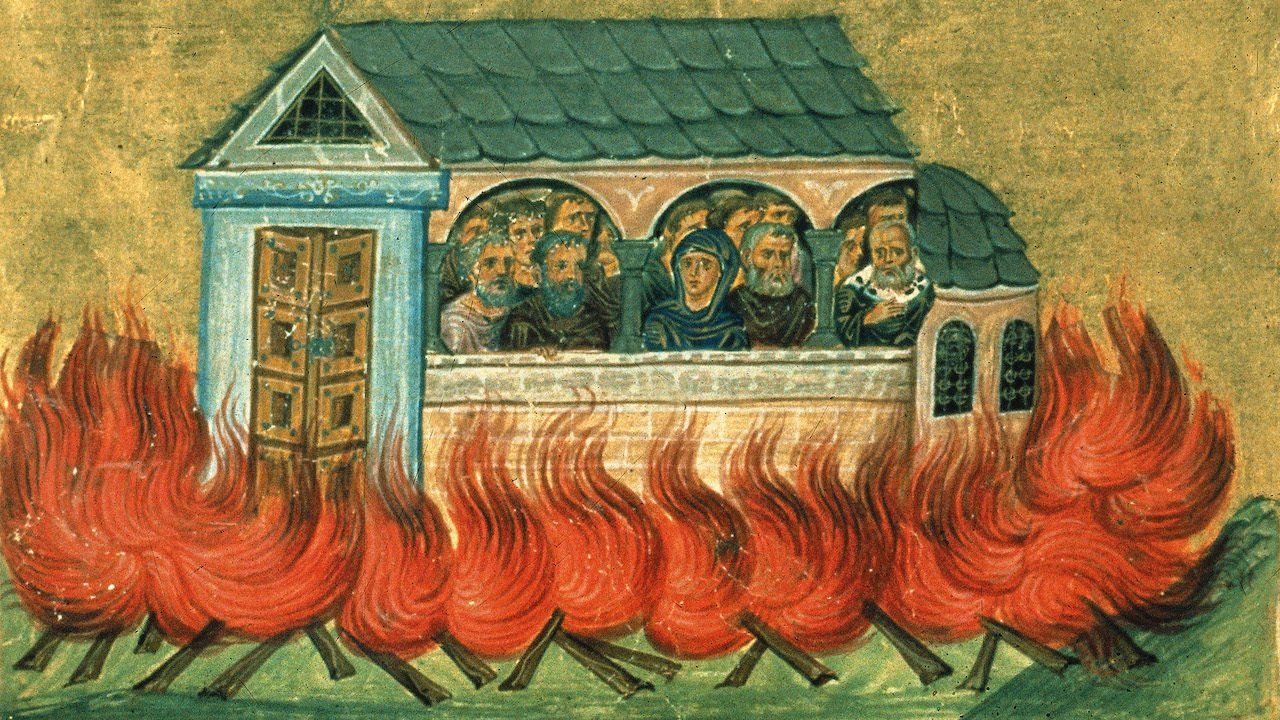
The 20,000 Martyrs of Nicomedia under Emperors Diocletian and Maximian in the early 4th century A.D.
There is a despair that is not easily recognizable as despair. And there is a hope that, to the superficial glance, may seem to be nothing but despair, even though it is hope of a most triumphant kind. Precisely this I call the “obscurity” of hope as well as of despair. I am not sure that every hope and all despair are necessarily always hard to identify; I only say, it is possible that hope as well as despair may appear at first sight in an unrecognizable form. We shall discuss this in the following.
Søren Kierkegaard gave to the obscure kind of despair the name “despair of weakness.” This despair, he says, consists of man not daring to be himself, even explicitly not wanting to be himself. He refuses to be what he truly is, he does not accept his own essence.
By this concept, “despair of weakness,” Kierkegaard returned, consciously or unconsciously, to an ancient thought of Western wisdom, namely, the notion of that special kind of “sloth” that, as acedia, is habitually counted among the seven capital sins (vitia capitalia). But present-day popular understanding has perverted the original concept of “sloth” as a capital sin into nearly its opposite. In ordinary usage “sloth” seems to have settled into the domain of work—understood as lack of diligence, laziness, lack of pleasure in work. But when the great masters of Western Christendom named this “sloth of the heart” a sin, it was not meant to be an approval of the ceaseless activity of the capitalist work establishment. Rather, acedia means that man does not “col-laborate” or work together with the realization of himself; that he refuses to add his conscious contribution to his very own, truly human existence. It is not at all a question of external activity but of the full realization of the self, to which we know we are silently but unmistakably summoned. And not to accept this summons, to respond to it with “no”: this is precisely the essence of “sloth,” of acedia. Through the sloth that is sin, man barricades himself against the challenge handed to him by his own dignity. He resists being a spiritual entity endowed with the power to make decisions; he simply does not want to be that for which God lifted him up above all natural potentiality. In other words, man does not want to be what he nevertheless cannot stop being: a spiritual being, truly satisfied with nothing less than God Himself; and beyond that, “son of God,” rightful heir to eternal life.
The ancients, too, thought of sloth and despair as belonging together. They call acedia a form of sadness, namely, that paralyzing tristitia saeculi of which Paul says that it brings death. But not only that. The ancients say explicitly that this sadness is already the beginning of despair—just as Kierkegaard understands the “despair of weakness” as the first step to actual and complete despair, the reflected “despair of self-assertion.” But where is that “obscurity” and “deception” which must be unmasked and exposed with special care?
It was already said that sloth, acedia, was considered a capital sin in the ancient wisdom. Caput means source. Vitia capitalia are those perversions from which, as from a fountainhead, more perversions gush forth. Thus it is meaningful and necessary to speak not only of the source itself, but of the whole length of the river nourished by it. If one proceeds in this manner, from the river’s mouth to its source, to the source-sin of sloth, then its relationship to the existential mode of man in our time suddenly becomes very apparent. It is totally impossible to overlook.
From not-wanting-to-be-oneself, from the refusal to collaborate with the completion of one’s own being, from this innermost conflict of man with himself, from this sloth (in a word), as the ancients say, springs the “roaming restlessness of the spirit.” He who is in conflict with himself in his inmost dwelling, who consequently does not will to be what he fundamentally is anyway, cannot dwell within himself and cannot be at home with himself. He has to make the vain experiment of breaking out from his own center—for example, into the restlessness of working for work’s sake or into the insatiable curiosity of the lustful eye, which does not really seek knowledge but only an “opportunity to abandon oneself to the world” (Heidegger), which is an opportunity to avoid oneself.
It must further be realized that both manifestations—the systematic establishment of the work ideal as absolute and the degeneration of the lustful eye—surround themselves with the immense effort of a forced optimism, of a radiating trust in life, of a noisily proclaimed “progress.” Everyone knows that belief in progress is declared a social duty in the world of nothing but work. It is also known that keep happy and happy end belong from the start to the basic elements of this world of illusions, in which the greedy eye has created for itself a replacement for the “fullness of life.”
For all that, these optimistic attitudes provide no final meaning in the face of the despair that is their source—even though this source is safely enclosed in the innermost chamber of the heart, so that no cry of pain penetrates to the outside, most likely not even to its own consciousness.
But there is also an obscure form of hope. We still need to speak of it.
All hope says: it will be good, it will end well—with all creation, with man, also with me. The Christian’s hope, too, means nothing else. The “good end” here is called: eternal life, salvation, beatitude, new heaven and new earth.
The Christian’s hope, however, cannot be separated from certain concepts about the structure of the world of history. And this is the reason that this hope, in the extreme case, can take on so much of the nature of obscurity that to the eye of the non-Christian it is nearly unrecognizable and comes to be seen almost as despair. This idea of the world of history, the world of humanity, says above all that evil, seen from a standpoint inside the world, may appear to be the superior power. The virtue of courage, for example, was always understood to be in itself, as Augustine says, an irrefutable sign of the existence and power of evil in the world. This explains what is in fact not so obvious, that in the Christian understanding of existence the highest incarnation of courage is not the powerful hero in arms but the martyr and that the highest act of courage is the testimony of blood.
For the martyr, to speak in worldly terms, there is no hope left; he is abandoned helplessly to the superior power of evil. Every vital optimism then becomes meaningless, and the natural ability to battle is literally handcuffed. For all that, the phenomenon of the martyr is unthinkable without a sheer triumphal strength of hope. This is the very hope of which I said it is so obscure as to be almost unrecognizable—not simply for the world and the non-Christian, but for the average Christian himself.
In the very obscurity of the martyr’s hope a main feature of all true Christian hope is visible: namely, that hope is a theological virtue. There is also a natural hope, obviously. But this natural hope is not a virtue because it is hope; this fact alone would not make it part of the true inner order of man. To put it more concretely: man is not set in the “true inner order” simply because he hopes for a happy old age or for the well-being of his children or for peace on earth or even that humanity may be saved from destroying itself. There can be no objection to any of these hopes; and one can call anyone blessed who is able to devote himself to them with undoubting confidence. But who would want to say that such hope belongs to the condition of being set right inwardly, simply meaning it to be a human “virtue”? This is a very different matter in the case of justice! The justice of natural man is also virtue. Hope only becomes virtue as theological hope, however, meaning a hope moving toward salvation, which does not exist in the natural world.
Even so, Christian hope does not fail to keep our historical created world in sight as well. One can read this, too, from the character of the Christian martyr. The Christian martyr is something truly incomparable. It is not enough to look at him as a man who dies for his conviction—as if the truth of this conviction did not matter. The distinction and the uniqueness of the Christian witness lies in the fact that in spite of the terror befalling him, from his mouth “no word against God’s creation is heard” (E. Peterson).
In the martyr’s hope three elements are joined together. The one thing truly hoped for is eternal life and not happiness found in the world. This is the first element. The second is the active “yes” to the created world in all its realms. The third element is the acceptance of a catastrophic end to the world of history.
The connection of these three elements is, logically, filled with dynamic tension; it is not easy to hold these tensions together and endure them. It means that the Christian’s hope is naturally always tempted to yield to an impermissible simplification—to a supernaturalism excluding history or to a pure activism within history or to a tragic attitude that is fatalistic and hostile to creation. And indeed, a detached examination of facts will come across such perversions of Christian hope again and again. Obviously, these perversions are not really founded on a difficulty in theoretical knowledge. It is primarily not man as he thinks but man as he spiritually exists in direct experience who is challenged when he is obliged to accept the apocalyptic dimension of history.
It therefore makes little sense to want to interpret and justify the painful silence of the martyr by means of rational argument: in this manner his hope does not emerge from its obscurity. Better and other ways are needed, it seems, than mere reflection and mental effort, if we are to succeed in perceiving the reality of that which lies in obscurity—the reality of the worldly man’s hidden despair as well as the victorious reality of the martyr’s hidden hope.
*From
Josef Pieper: An Anthology (San Francisco: Ignatius Press, 1989), pp. 22-27. Available for purchase at
Eighth Day Books.
Share this Post on Your Preferred Platform