Unrivaled Beauty as Source of All Beauty
The God of the Universe
by St Gregory of Nyssa
Feast of St Jason & Sosipater the Apostles of the 70 & Their Companions
Anno Domini 2020, April 29
NOW THOSE
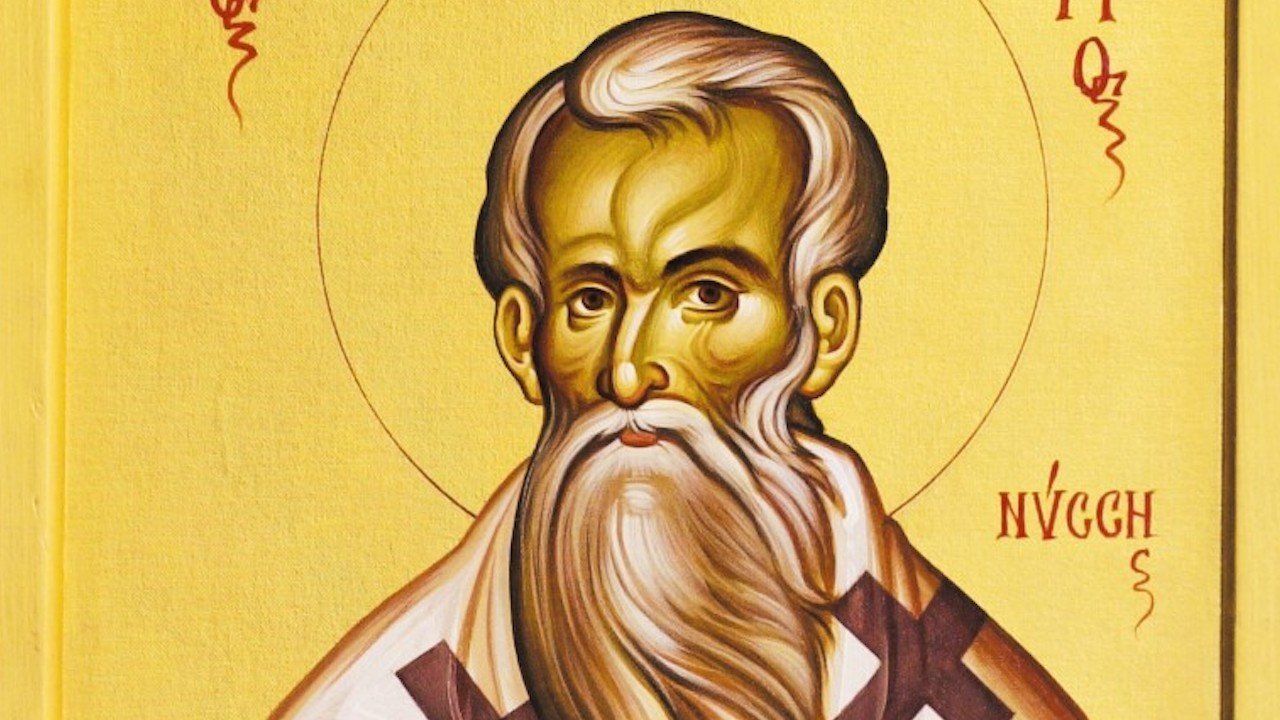
who take a superficial and unreflecting view of things observe the outward appearance of anything they meet, e.g. of a man, and then trouble themselves no more about him. The view they have taken of the bulk of his body is enough to make them think that they know all about him. But the penetrating and scientific mind will not trust to the eyes alone the task of taking the measure of reality; it will not stop at appearances, nor count that which is not seen among unrealities. It inquires into the qualities of the man’s soul. It takes those of its characteristics which have been developed by his bodily constitution, both in combination and singly; first singly, by analysis, and then in that living combination which makes the personality of the subject. As regards the inquiry into the nature of beauty, we see, again, that the man of half-grown intelligence, when he observes an object which is bathed in the glow of a seeming beauty, thinks that that object is in its essence beautiful, no matter what it is that so prepossesses him with the pleasure of the eye. He will not go deeper into the subject. But the other, whose mind’s eye is clear, and who can inspect such appearances, will neglect those elements which are the material only upon which the Form of Beauty works; to him they will be but the ladder by which he climbs to the prospect of that Intellectual Beauty, in accordance with their share in which all other beauties get their existence and their name. But for the majority, I take it, who live all their lives with such obtuse faculties of thinking, it is a difficult thing to perform this feat of mental analysis and of discriminating the material vehicle from the immanent beauty, and thereby of grasping the actual nature of the Beautiful; and if any one wants to know the exact source of all the false and pernicious conceptions of it, he would find it in nothing else but this, viz. the absence, in the soul’s faculties of feeling, of that exact training which would enable them to distinguish between true Beauty and the reverse. Owing to this men give up all search after the true Beauty. Some slide into mere sensuality. Others incline in their desires to dead metallic coin. Others limit their imagination of the beautiful to worldly honors, fame, and power. There is another class which is enthusiastic about art and science. The most debased make their gluttony the test of what is good. But he who turns from all grosser thoughts and all passionate longings after what is seeming, and explores the nature of the beauty which is simple, immaterial, formless, would never make a mistake like that when he has to choose between all the objects of desire; he would never be so misled by these attractions as not to see the transient character of their pleasures and not to win his way to an utter contempt for every one of them. This, then, is the path to lead us to the discovery of the Beautiful. All other objects that attract men’s love, be they never so fashionable, be they prized never so much and embraced never so eagerly, must be left below us, as too low, too fleeting, to employ the powers of loving which we possess; not indeed that those powers are to be locked up within us unused and motionless; but only that they must first be cleansed from all lower longings; then we must lift them to that height to which sense can never reach. Admiration even of the beauty of the heavens, and of the dazzling sunbeams, and, indeed, of any fair phenomenon, will then cease. The beauty noticed there will be but as the hand to lead us to the love of the supernal Beauty whose glory the heavens and the firmament declare, and whose secret the whole creation sings. The climbing soul, leaving all that she has grasped already as too narrow for her needs, will thus grasp the idea of that magnificence which is exalted far above the heavens. But how can any one reach to this, whose ambitions creep below? How can any one fly up into the heavens, who has not the wings of heaven and is not already buoyant and lofty-minded by reason of a heavenly calling? Few can be such strangers to evangelic mysteries as not to know that there is but one vehicle on which man’s soul can mount into the heavens, viz. the self-made likeness in himself to the descending Dove, whose wings David the Prophet also longed for. This is the allegorical name used in Scripture for the power of the Holy Spirit; whether it be because not a drop of gall is found in that bird, or because it cannot bear any noisome smell, as close observers tell us. He therefore who keeps away from all bitterness and all the noisome effluvia of the flesh, and raises himself on the aforesaid wings above all low earthly ambitions, or, more than that, above the whole universe itself, will be the man to find that which is alone worth loving, and to become himself as beautiful as the Beauty which he has touched and entered, and to be made bright and luminous himself in the communion of the real Light. We are told by those who have studied the subject, that those gleams which follow each other so fast through the air at night and which some call shooting stars, are nothing but the air itself streaming into the upper regions of the sky under stress of some particular blasts. They say that the fiery track is traced along the sky when those blasts ignite in the ether. In like manner, then, as this air round the earth is forced upwards by some blast and changes into the pure splendor of the ether, so the mind of man leaves this murky miry world, and under the stress of the spirit becomes pure and luminous in contact with the true and supernal Purity; in such an atmosphere it even itself emits light, and is so filled with radiance, that it becomes itself a Light, according to the promise of our Lord that the righteous should shine forth as the sun (Matt. 13:43). We see this even here, in the case of a mirror, or a sheet of water, or any smooth surface that can reflect the light; when they receive the sunbeam they beam themselves; but they would not do this if any stain marred their pure and shining surface. We shall become then as the light, in our nearness to Christ’s true light, if we leave this dark atmosphere of the earth and dwell above; and we shall be light, as our Lord says somewhere to His disciples, if the true Light that shines in the dark comes down even to us; unless, that is, any foulness of sin spreading over our hearts should dim the brightness of our light. Perhaps these examples have led us gradually on to the discovery that we can be changed into something better than ourselves; and it has been proved as well that this union of the soul with the incorruptible Deity can be accomplished in no other way but by herself attaining by her virgin state to the utmost purity possible — a state which, being like God, will enable her to grasp that to which it is like, while she places herself like a mirror beneath the purity of God, and molds her own beauty at the touch and the sight of the Archetype of all beauty. Take a character strong enough to turn from all that is human, from persons, from wealth, from the pursuits of Art and Science, even from whatever in moral practice and in legislation is viewed as right (for still in all of them error in the apprehension of the Beautiful comes in, sense being the criterion); such a character will feel as a passionate lover only towards that Beauty which has no source but Itself, which is not such at one particular time or relatively only, which is Beautiful from, and through, and in itself, not such at one moment and in the next ceasing to be such, above all increase and addition, incapable of change and alteration. I venture to affirm that, to one who has cleansed all the powers of his being from every form of vice, the Beauty which is essential, the source of every beauty and every good, will become visible. The visual eye, purged from its blinding humor, can clearly discern objects even on the distant sky; so to the soul by virtue of her innocence there comes the power of taking in that Light; and the real Virginity, the real zeal for chastity, ends in no other goal than this, viz. the power thereby of seeing God. No one in fact is so mentally blind as not to understand that without telling; viz. that the God of the Universe is the only absolute, and primal, and unrivalled Beauty and Goodness. All, maybe, know that; but there are those who, as might have been expected, wish besides this to discover, if possible, a process by which we may be actually guided to it. Well, the Divine books are full of such instruction for our guidance; and besides that many of the Saints cast the refulgence of their own lives, like lamps, upon the path for those who are walking with God. But each may gather in abundance for himself suggestions towards this end out of either Covenant in the inspired writings; the Prophets and the Law are full of them; and also the Gospel and the Traditions of the Apostles. What we ourselves have conjectured in following out the thoughts of those inspired utterances is this.
~ On Virginity, Ch. 11
Share this Post on Your Preferred Platform

Inside the head of my three-month-old granddaughter, Lucy, said G.K. Chesterton is, "a new universe, as new as it was on the seventh day of creation...a new system of stars, new grass, new cities...and new seas." And this is because, he adds: The gravity of astonishment at the universe...dwells in the eyes of a baby three-months-old [and] the universe is put upon its trial and forces us actually to remodel our conduct...we seem to be dealing with a new race, only to be seen through a microscope...[with] delightful bulbous heads, three times too big for the body. But Chesterton's central thesis in this essay is not that babies are so marvelous, but that our treatment of each other as adults, in contrast, is so broken. "It is our attitude towards grown-up people that is wrong," he writes, because we no longer see each other with astonishment and wonder (unless, that is, we are falling in love). But babies remind us that humans really are astonishing, and this "revolutionary theory of the marvelousness of all things" should force us to "remodel our conduct" toward everyone we meet. A baby seems to be a necessary icon for us, correcting our eyesight which grows old and struggles to see "the weight of glory" in each other as teenagers, adults, and perhaps especially, as old people. Even though he did not reference icons in his essay, we seem to drift very easily into what could be called a type of iconoclasm, an inability to see each other as image bearers of God Himself. William Wordsworth describes us as "trailing clouds of glory" when we first arrive here "from God, who is our home." But soon, he says, "shades of the prison-house" begin to smother us, and we forget. "We bow to grown people," says Chesterton in this same essay, "take off our hats to them, refrain from contradicting them flatly, but we do not appreciate them properly." God speaks to us, like we are working through in St. John of Damascus , through the "cataphatic or apophatic spectrum of theology," or literally from the spoken word (cataphatic) or unspeakable word (apophatic). Apophatic I noticed has the same root in Greek as Infant does in Latin. Both mean "unspoken." God has given us both bibles and babies, speechless wonders through which He means to unglaze our eyes and fill us with astonishment. MARK C. WATNEY is professor emeritus at Sterling College, assisting in its newly established C. S. Lewis Center. He has given papers at Harvard's Center for Hellenic Studies and Dordt College

"God became man, so that man might become God." St. Athanasius the Great, On the Incarnation (54:3) These words from St. Athanasius may sound, at first blush, provocative. However, St. Athanasius is restating, perhaps more simply, what St. Peter says in his second epistle: the promise of being united to Christ is that men and women made in His image will partake in His divine nature (2 Peter 1:4). Paul Kingsnorth's latest book, Against the Machine, inverts this idea and opens our eyes to the world emerging at a rapid rate, the world dominated by what he calls The Machine. The new mantra of The Machine age is, instead, this: Man will become God by Man's own self-creation. Reading Kingsnorth is not for the faint of heart. It's easy to be overcome by despair. The goal of the Machine age is "transhumanism", to be liberated from the constraints of the body. For the transhumanist (self-described), the future is disembodied. The future is limitless. But this is not liberation. Because the Machine is not limited to the physical world, it follows naturally there is a spiritual nature to this lifestyle, what he ultimately identifies as a manisfestation and/or manipulation of the demonic. Whether or not you agree with his ultimate conclusion, we can see its effects. An entire generation, and many across generations, addicted to screens. Disintegration of communal life, most disastrously in the breakdown of the family. Increasing rates of loneliness, depression, and suicide, especially among children. It's clear we need a Savior, and the Machine isn't it. Instead, Kingsnorth encourages us toward a revival of community, men, women, and children living embodied lives in the same space and time: working together, eating together, worshipping together, loving each other, carrying each other's burdens. If this sounds like Eighth Day Institute...if this sounds like what the Church is meant to be, it is because this is exactly what the Church is. We are saved together in Christ. MICHAEL SIMMON currently serves as the Secretary of Eighth Day Institute Board of Directors and Coordinator for Hall of Men. He resides in Wichita, Kansas with his wife and four children.
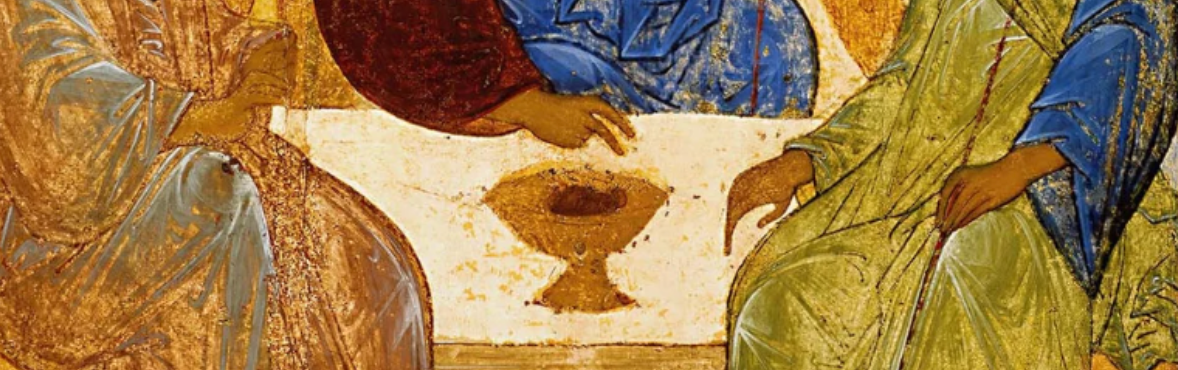
"What is it that has ordered the things of heaven and those of earth, the things which move through the air and those which move in the water; nay, rather the things which proceeded them: heaven and earth and the natures of fire and water? What is it that combined and arranged them...set them into motion and put them on their unceasing and unhindered course?..But who is the architect of these things? Or did not he who made them also bring them into being? We shall certainly not attribute such power to spontaneity." On the Orthodox Faith, Chapter 3 This comes after St. John of Damascus sets out to delineate between the created and the uncreated, a fact which, while at the core of existence, seems for him to be, for this very reason, the simplest to believe. Everything but God is created and, thus, susceptible to change. This means people, but this also means demons, angels, the rest of the created order across the entire cosmos. Everything is vulnerable to unrest. Except for God. If you have ever tried to explain the Holy Trinity to a child for the first time, maybe you have felt as I have the weightier, inexpressible side of God's unchangeability: how do I possibly communicate this essential fact to the person in front of me? (This is usually when my faint stutter starts to pop up again.) I like that here, like St. Patrick reaching for a three-leaf clover, St. John brings us back to earth to better understand the cosmos. Fire and water are no less mysteries than heaven and earth. And yet here we are, cooking and washing, eating and drinking, filled and sustained on what we can neither fully explain nor claim to have created. Only God is unchanging. Vice versa, God is the only constant we need. Maybe the rest is better left unsaid. LUKE TAYLOR GILSTRAP is Vice President of the Board of Directors for Eighth Day Institute. His poems have appeared in Spiritus, Ekstasis (Christianity Today), and Relief Journal, among others. He lives happily in Wichita, Kansas with his wife and three sons.

"Now, one who would speak or hear about God should know beyond any doubt that in what concerns theology and the Incarnation not all things are inexpressible and not all are capable of expression, and neither are all things unknowable nor are they all knowable. That which can be known is one thing, whereas that which can be said is another, just as it is one thing to speak and another to know. Furthermore, many of those things about God which are not clearly perceived cannot be fittingly described, so that we are obliged to express in human terms things which transcend the human order. Thus, for example, in speaking about God we attribute to Him sleep, anger, indifference, hands and feet, and the like." On the Orthodox Faith, Chapter 2 When I was studying Fiction in graduate school, one of the first methods I learned to really situate the reader in the story you were about to tell them was disorientation; if you wanted to ground them in one story, first you had pull the rug out from under their feet. So it's fitting that in the beginning of St. John Damascene's On the Orthodox Faith, before rebuilding our foundation, he first puts us squarely in limbo, seesawing back and forth between certainty and uncertainty. To paraphrase, there is no doubt (certainty) that about God some things can be expressed...but not all things (uncertainty). Some things about God are truly knowable (certainty), but some are unknowable (uncertainty). Oh, and while we're speaking about God (certainty), let's admit there's a gap, too, between what we say and what we know (uncertainty). My favorite line in this spiraling excerpt, "...it is one thing to speak, and another to know," takes me back to the final lines in Wendell Berry's poem, "How to Be a Poet," which he wrote primarily as a reminder to himself: Accept what comes from silence. Make the best you can of it. Of the little words that come out of the silence, like prayers prayed back to the one who prays, make a poem that does not disturb the silence from which it came. Wherever your preferences fall on the cataphatic or apophatic spectrum of theology (whether you lean more toward what we can say about God or what we cannot), Berry's poem, I think, would nod along with St. John: before we say too much, let our words be preserved by the silence from which they came. I'm thinking of the silence, that filling, restorative quiet I feel when I step into a cathedral or in some of my favorite moments with my kids in the early hours. Even before praying, can we hear the One already praying in us? Let's start there. LUKE TAYLOR GILSTRAP is Vice President of the Board of Directors for Eighth Day Institute. His poems have appeared in Spiritus, Ekstasis (Christianity Today), and Relief Journal, among others. He lives happily in Wichita, Kansas with his wife and three sons.
Late-Night Bookstores and Spiritual Reading
On St. Benedict and the Making of Vows

The Pursuit of Truth in the Age of AI

On the Theology of Raising Chickens

G.K. Chesterton and Raising Small Children

"Seal of the Fathers"