A Brief Biography of Dorothy L. Sayers

by Alzina Stone Dale


Feast of St. Luke the Evangelist

Anno Domini 2023, October 18
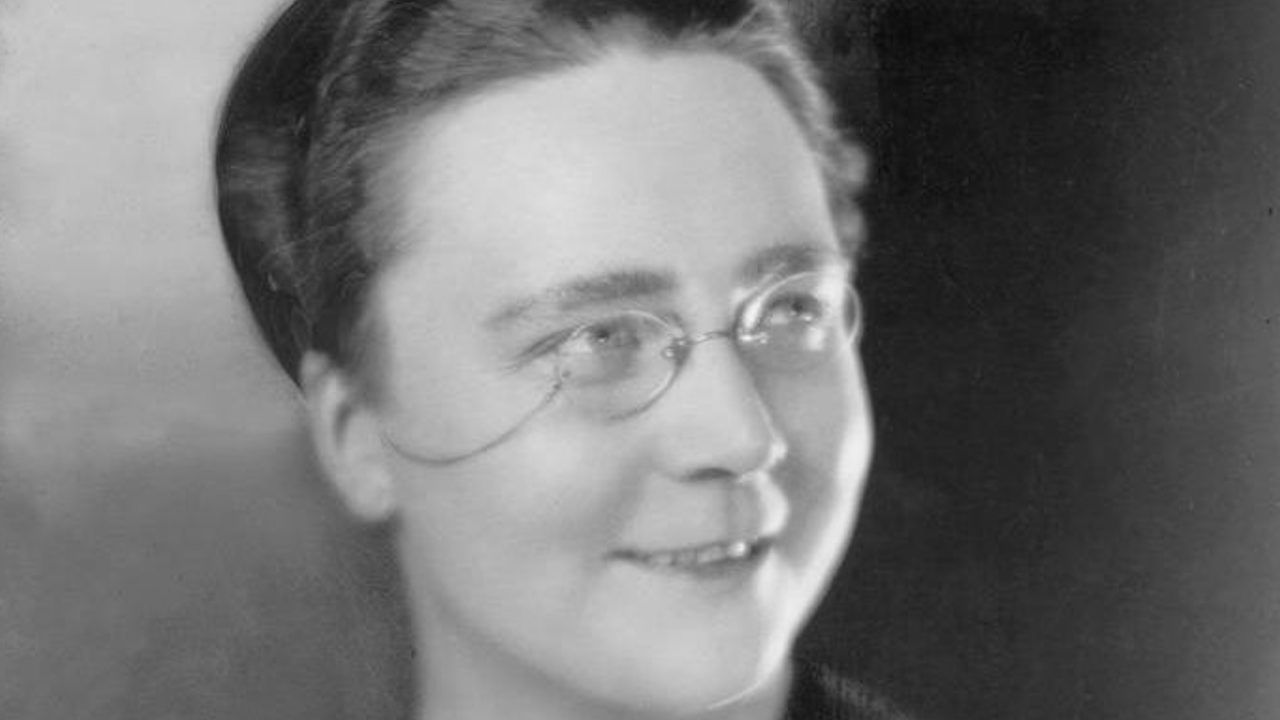
A brief summary of her life may help those who have not read any of the biographies. Born the only child of the Reverend Henry and Helen Mary Sayers in her beloved Oxford, she was four when her family moved to the Fens. While both parents early recognized her intelligence, it was her mother who not only was determined that Dorothy should have a university education but encouraged her to become a professional writer.


It was at Oxford University’s Somerville College that she made the friends and established the pattern of her working life, for Sayers was not a solitary journal keeper but a letter writer who shared her work in progress with all interested friends, eagerly enlisting them in any current project. C. S. Lewis jokingly wrote her that if her letters were ever published she might find that her true fame rested upon them, not her published books. This has not happened yet because there are so many of them: over 30,000 pages in the Wade Center Collection alone. But in them you can hear the unmistakable voice, half poetic, half amused, describing the world about her with a discerning if tolerant eye, and the realistic details that created the ambience she called “particularity,” the characteristic that has made her mysteries, firmly set in time and place, such excellent social history.


Dorothy later described herself as a child as a little prig, but she always showed her redeeming grace—a lively sense of humor. Despite an adult life with truly serious problems, including serving as the chief support for her illegitimate son as well as her “war-wounded” husband, Sayers maintained her energetic and enthusiastic manner, refusing to become a pessimist even when World War II, for which she and her generation felt responsible, broke out. Her innate sense of values, based upon the fundamental assumption of Western civilization, were so much a part of her that, in talking about her as an artistic role model, each of the contributors to this book [Dorothy L. Sayers: The Centenary Celebration] ends by discussing her philosophical point of view.


Out of college Sayers taught, tried publishing, then took a copywriting job in London about the time her first mystery, Whose Body?, appeared in print. Lord Peter Wimsey, created to be her breadwinner, did so nobly. But as she became better known and got her toe inside the stage door, where everyone was a comrade in arms working toward a common goal, her desire to keep churning out a mystery or two each year flagged. Her interest in the Wimseys themselves never ended, but she kept them for her spare time and close friencd, as she, thanks to World War II, became more and more involved in war work. She began to write plays on more obviously religious themes, particularly her magnificent cycle on the life of Christ, which made Him real to the mid-twentieth century. This was followed finally by her great gift to the postwar world, her lively translation of Dante. His work (and personality) fit her own so very well that her friend Barbara Reynolds argues convincingly that it was Dante the writer, not Lord Peter, the fictional lord, who was her ideal man.


When Sayers died suddenly of a stroke on December 17, 1957, she left Paradise unfinished, to be completed by Barbara Reynolds, the latest in the long list of Sayers’s devoted friends.


*Originally published in Alzina Stone Dale, ed., Dorothy L. Sayers: The Centenary Celebration (iUniverse, Inc., 2005), pp. 151-152.

Share this Post on Your Preferred Platform

By Luke Taylor Gilstrap July 31, 2026
"What is it that has ordered the things of heaven and those of earth, the things which move through the air and those which move in the water; nay, rather the things which proceeded them: heaven and earth and the natures of fire and water? What is it that combined and arranged them...set them into motion and put them on their unceasing and unhindered course?..But who is the architect of these things? Or did not he who made them also bring them into being? We shall certainly not attribute such power to spontaneity." On the Orthodox Faith, Chapter 3 This comes after St. John of Damascus sets out to delineate between the created and the uncreated, a fact which, while at the core of existence, seems for him to be, for this very reason, the simplest to believe. Everything but God is created and, thus, susceptible to change. This means people, but this also means demons, angels, the rest of the created order across the entire cosmos. Everything is vulnerable to unrest. Except for God. If you have ever tried to explain the Holy Trinity to a child for the first time, maybe you have felt as I have the weightier, inexpressible side of God's unchangeability: how do I possibly communicate this essential fact to the person in front of me? (This is usually when my faint stutter starts to pop up again.) I like that here, like St. Patrick reaching for a three-leaf clover, St. John brings us back to earth to better understand the cosmos. Fire and water are no less mysteries than heaven and earth. And yet here we are, cooking and washing, eating and drinking, filled and sustained on what we can neither fully explain nor claim to have created. Only God is unchanging. Vice versa, God is the only constant we need. Maybe the rest is better left unsaid. LUKE TAYLOR GILSTRAP is Vice President of the Board of Directors for Eighth Day Institute. His poems have appeared in Spiritus, Ekstasis (Christianity Today), and Relief Journal, among others. He lives happily in Wichita, Kansas with his wife and three sons.
By Luke Taylor Gilstrap July 24, 2026
"Now, one who would speak or hear about God should know beyond any doubt that in what concerns theology and the Incarnation not all things are inexpressible and not all are capable of expression, and neither are all things unknowable nor are they all knowable. That which can be known is one thing, whereas that which can be said is another, just as it is one thing to speak and another to know. Furthermore, many of those things about God which are not clearly perceived cannot be fittingly described, so that we are obliged to express in human terms things which transcend the human order. Thus, for example, in speaking about God we attribute to Him sleep, anger, indifference, hands and feet, and the like." On the Orthodox Faith, Chapter 2 When I was studying Fiction in graduate school, one of the first methods I learned to really situate the reader in the story you were about to tell them was disorientation; if you wanted to ground them in one story, first you had pull the rug out from under their feet. So it's fitting that in the beginning of St. John Damascene's On the Orthodox Faith, before rebuilding our foundation, he first puts us squarely in limbo, seesawing back and forth between certainty and uncertainty. To paraphrase, there is no doubt (certainty) that about God some things can be expressed...but not all things (uncertainty). Some things about God are truly knowable (certainty), but some are unknowable (uncertainty). Oh, and while we're speaking about God (certainty), let's admit there's a gap, too, between what we say and what we know (uncertainty). My favorite line in this spiraling excerpt, "...it is one thing to speak, and another to know," takes me back to the final lines in Wendell Berry's poem, "How to Be a Poet," which he wrote primarily as a reminder to himself: Accept what comes from silence. Make the best you can of it. Of the little words that come out of the silence, like prayers prayed back to the one who prays, make a poem that does not disturb the silence from which it came. Wherever your preferences fall on the cataphatic or apophatic spectrum of theology (whether you lean more toward what we can say about God or what we cannot), Berry's poem, I think, would nod along with St. John: before we say too much, let our words be preserved by the silence from which they came. I'm thinking of the silence, that filling, restorative quiet I feel when I step into a cathedral or in some of my favorite moments with my kids in the early hours. Even before praying, can we hear the One already praying in us? ​​​​​​​Let's start there. LUKE TAYLOR GILSTRAP is Vice President of the Board of Directors for Eighth Day Institute. His poems have appeared in Spiritus, Ekstasis (Christianity Today), and Relief Journal, among others. He lives happily in Wichita, Kansas with his wife and three sons.
By Mark C. Watney July 20, 2026
Late-Night Bookstores and Spiritual Reading
By Sarah Orner July 20, 2026
On St. Benedict and the Making of Vows
By Luke Taylor Gilstrap July 20, 2026
The Pursuit of Truth in the Age of AI
By Michael Simmon July 20, 2026
On the Theology of Raising Chickens
By Luke Taylor Gilstrap July 20, 2026
G.K. Chesterton and Raising Small Children
By Fr. Mark Lovett June 9, 2026
"Seal of the Fathers"
By Luke Taylor Gilstrap June 9, 2026
In Memory of Warren Farha, 1955-2026
By Jeremy Wagner May 15, 2026
An Ode to St. Brendan the Voyager
More Posts