A Panegyric for Dorothy Sayers
by C. S. Lewis
Feast of St. Luke the Evangelist
Anno Domini 2023, October 18
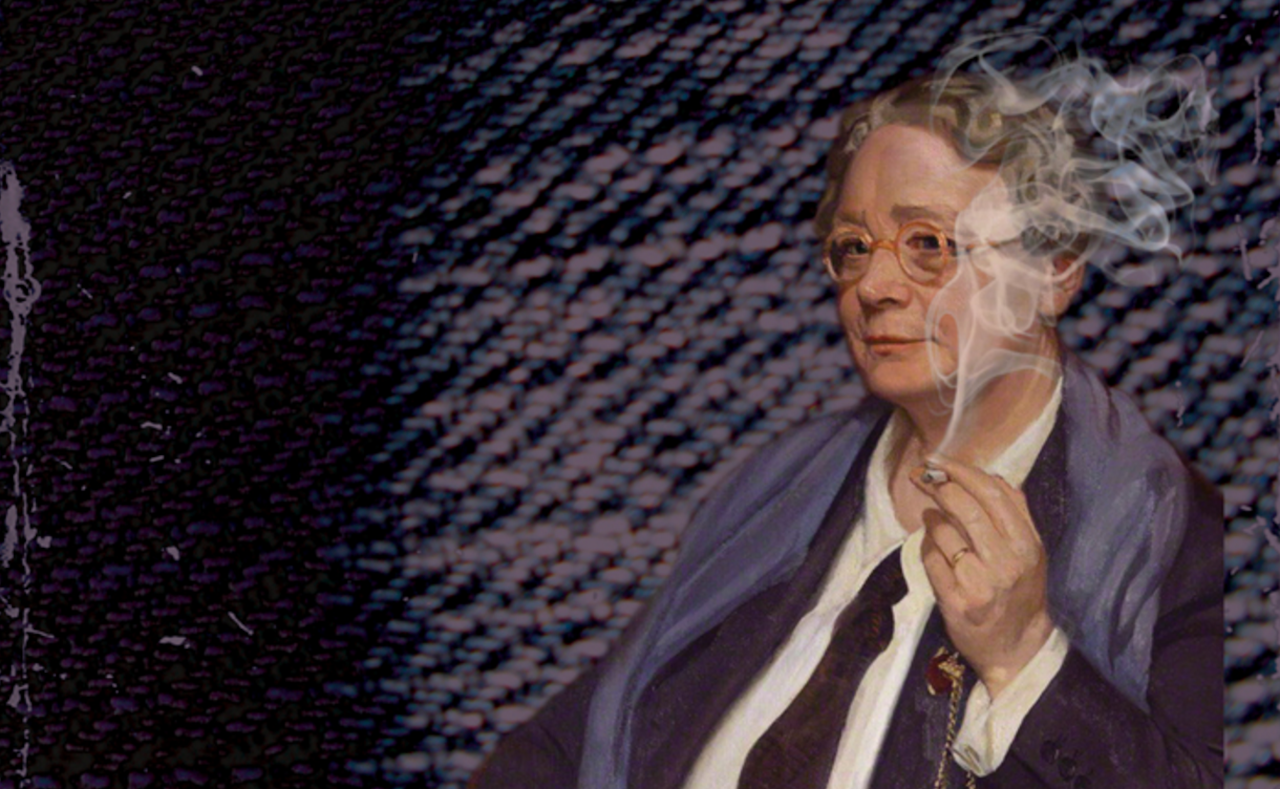
The variety of Dorothy Sayers’ work makes it almost impossible to find anyone who can deal properly with it all. Charles Williams might have done so; I certainly can’t. It is embarrassing because, in our present state of festering intellectual class consciousness, the admission might be taken as a boast. It is nothing of the sort: I respect, though I do not much enjoy, that severe and civilized form, which demands much fundamental brain work of those who write in it and assumes as its background uncorrupted and unbrutalised methods of criminal investigation.
Prigs have put it about that Dorothy in later life was ashamed of her “tekkies” and hated to hear them mentioned. A couple of years ago my wife asked her if this was true and was relieved to hear her deny it. She had stopped working in that genre because she felt she had done all she could with it. And indeed, I gather, a full process of development had taken place. I have heard it said that Lord Peter is the only imaginary detective who ever grew up—grew from the Duke’s son, the fabulous amorist, the scholar swashbuckler, and connoisseur of wine, into the increasingly human character, not without quirks and flaws, who loves and marries, and is nursed by, Harriet Vane. Reviewers complained that Miss Sayers was falling in love with her hero. On which a better critic remarked to me, “It would be truer to say she was falling out of love with him; and ceased fondling a girl’s dream—if she had ever done so—and began inventing a man.”
There is in reality no cleavage between the detective stories and her other works. In them, as in it, she is first and foremost the craftsman, the professional. She always saw herself as one who has learned a trade, and respects it, and demands respect for it from others. We who loved her may (among ourselves) largely admit that this attitude was sometimes almost comically emphatic. One soon learned that “We authors, Ma’am” was the most acceptable key [This expression, attributed to Benjamuun Disraeli, was found to have a soothing effect upon Queen Victoria.]. Gas about “inspiration,” whimperings about critics or public, all the paraphernalia of dandyisme and “outsidership” were, I think, simply disgusting to her. She aspired to be, and was, at once a popular entertainer and a conscientious craftsman: like (in her degree) Chaucer, Cervantes, Shakespeare, or Molière. I have an idea that, with a very few exceptions, it is only such writers who matter much in the long run. “One shows one’s greatness,” says Pascal, “not by being at an extremity but by being simultaneously at two extremities.” Much of her most valuable thought about writing was embodied in The Mind of the Maker: a book which is still too little read. It has faults. But books about writing by those who have themselves written viable books are too rare and too useful to be neglected.
For a Christian, of course, this pride in one’s craft, which so easily withers into pride in oneself, raises a fiercely practical .. It is delightfully characteristic of her extremely robust and forthright nature that she soon lifted this problem to the fully conscious level and made it the theme of one of her major works. The architect in The Zeal of Thy House is at the outset the incarnation of—and therefore doubtless the Catharsis from—a possible Dorothy who the actual Dorothy Sayers was offering for mortification. His disinterested zeal for the work itself has her full sympathy. But she knows that, without grace, it is a dangerous virtue: little better than the “artistic conscience” which every Bohemian bungler pleads as a justification for neglecting his parents, deserting his wife, and cheating his creditors. From the beginning, personal pride is entering into the architect’s character: the play records his costly salvation.
As the detective stories do not stand quite apart, so neither do the explicitly religious works. She never sank the artist and entertainer in the evangelist. The very astringent (and admirable) preface to The Man Born to Be King, written when she had lately been assailed with a great deal of ignorant and spiteful obloquy, makes the point of view defiantly clear. “It was assumed,” she writes, “that my object in writing was ‘to do good.’ But that was in fact not my object at all, though it was quite properly the object of those who commissioned the plays in the first place. My object was to tell that story to the best of my ability, within the medium at my disposal—in short, to make as good a work of art as I could. For a work of art that is not good and true in art is not true and good in any other respect.” Of course, while art and evangelism were distinct, they turned out to demand one another. Bad art on this theme went hand in hand with bad theology. “Let me tell you, good people, an honest writer would be ashamed to treat a nursery tale as you have treated the greatest drama in history: and this in virtue, not of his faith, but of his calling.” And equally, of course, her disclaimer of an intention to “do good” was ironically rewarded by the immense amount of good she evidently did.
The architectonic qualities of this dramatic sequence will hardly be questioned. Some tell me they find it vulgar. Perhaps they do not quite know what they mean; perhaps they have not fully digested the answers to this charge given in the preface. Or perhaps it is simply not “addressed to their condition.” Different souls take their nourishment in different vessels. For my own part, I have re-read it in every Holy Week since it first appeared, and never re-read it without being deeply moved.
Her later years were devoted to translation. The last letter I ever wrote to her was in acknowledgement of her Song of Roland, and I was lucky enough to say that the end-stopped lines and utterly unadorned style of the original must have made it a far harder job than Dante. Her delight at this (surely not very profound) remark suggested that she was rather starved for rational criticism. I do not think this one of her most successful works. It is too violently colloquial for my palate; but then, she knew far more Old French than I. In her Dante the problem is not quite the same. It should always be read in conjunction with the paper on Dante which she contributed to the Essays Presented to Charles Williams [Link to “‘…And Telling You a Story’: A Note on the Divine Comedy”]. There you get the first impact of Dante on a mature, a scholarly, and an extremely independent mind. That impact determined the whole character of her translation.
She had been startled and delighted by something in Dante for which no critic, and no earlier translator, had prepared her: his sheer narrative impetus, his frequent homeliness, his high comedy, his grotesque buffoonery. These qualities she was determined to preserve at all costs. If, in order to do so, she had to sacrifice sweetness or sublimity, then sacrificed they should be. Hence her audacities in both language and rhythm.
We must distinguish this from something rather discreditable that has been going on of recent years—I mean the attempt of some translators from Greek and Latin to make their readers believe that the Aeneid is written in service slang and that Attic Tragedy uses the language of the streets. What such versions implicitly assert is simply false; but what Dorothy was trying to represent by her audacities is quite certainly there in Dante. The questions is how far you can do it justice without damage to other qualities which are also there and thus misrepresenting the Comedy as much in one direction as fussy, Miltonic old Cary had done in the other [The Vision; or, Hell, Purgatory, and Paradise, of Dante Alighieri, trans. by Rev. Henry Francis Cary (London: William Smith, 1844)]. In the end, I suppose, one comes to a choice of evils. No version can give the whole of Dante. So at least I said when I read her Inferno. But, then, when I came to the Purgatorio, a little miracle seemed to be happening. She had risen, just as Dante himself rose in his second part: growing richer, more liquid, more elevated. Then first I began to have great hopes for her Paradiso. Would she go on rising? Was it possible? Dare we hope?
Well. She died instead; went, as one may in all humility hope, to learn more of Heaven than even the Paradiso could tell her. For all she did and was, for delight and instruction, for her militant loyalty as a friend, for courage and honesty, for the richly feminine qualities which showed through a port and manner superficially masculine and even gleefully ogreish—let us thank the Author who invented her.
*Published in On Stories and Other Essays on Literature, ed. Walter Hooper (London: Harcourt Brace Jovanovich, 1966), 91-95.
Share this Post on Your Preferred Platform