Inklings Festival Presentations: Oikophilia in David Jones, Visions of Paradise, and Saving the Shire
by Erin Doom
Feast of the Holy Wonderworkers and Unmercenaries Cosmas & Damian of Asia, and Their Mother Theodota
Anno Domini 2020, November 1
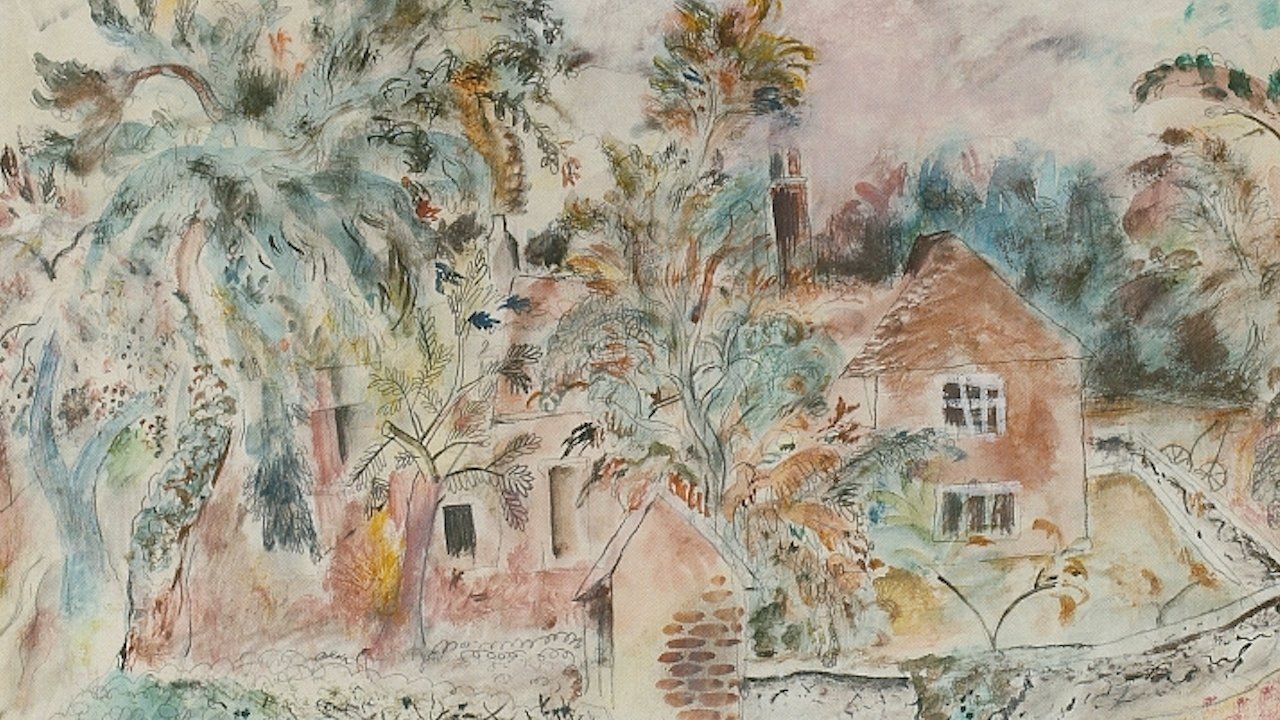
Homestead in Buckinghamshire by David Jones (1931)
Two opening comments...
First, I'm still working on the digital content from the Inklings Festival. You'll receive those videos soon, along with Vigen Guroian's Inklings Lecture from last year on George Macdonald (and a bonus review on Macdonald's works Lilith and Phantastes by W. H. Auden).
Second, next weekend I’ll begin including a new piece at least twice a month in the premium blogs (Florovsky Archive and The Moot) for Patrons and Pillars. The next issue will include a short piece by Florovsky for which I’ve been searching for several years. Last week, while visiting the Monastery of the Holy Archangel Michael in Cañones, NM, abbot Fr. Silouan took me right to it in the monastery library. I snapped a picture of the two pages and will have it transcribed for you next weekend. The end is so great, part of it will be the quote on the next Hall of Men bookmark (2021). Stay tuned.
Meanwhile, this issue of Synaxis does include the texts of all the presentations from the recent sixth annual 2020 Inklings Festival. Dig in and offer a toast to the Inklings!
1. Bible
Monday: Col. 2:13-20. Lk. 11:29-33. Online here.
Tuesday: Col. 2:20-23; 3:1-3. Lk. 11:34-41. Online here.
Wednesday: Col. 3:17-25; 4:1. Lk. 11:42-46. Online here.
2. Liturgy: Feast of Cosmas & Damian the Holy Unmercenaries of Asia, and their Mother Theodota
One of three sets of Holy Unmercenaries commemorated by the names Cosmas and Damian (of Rome on July 1 and of Arabia on October 17), their mother St. Theodota, by example and by reading holy books to them, raised them to be virtuous men. Trained as physicians, they received the gift of healing people’s illnesses of body and soul by the power of prayer through the Holy Spirit. Learn more about their lives and some of the miraculous healings they performed here.
Troparion — Tone 8: Holy unmercenaries and wonderworkers, Cosmas and Damian, heal our infirmities. Freely you have received; freely you give to us.
Kontakion — Tone 2: Having received the grace of healing, you grant healing to those in need. Glorious wonder workers and healers, Cosmas and Damian, visit us and put down the insolence of our enemies, and bring healing to the world through your miracles.
3. Fathers: “Three Foes of the Family” by G. K. Chesterton
This is a stretch again, but since we’re wrapping up the 2020 Inklings Festival, I’m including a “father” of the Inklings today. This one might be a bit controversial but it’s worth reading and considering, especially in light of our theme of “oikophilia.” To spill the controversial beans, here’s one sentence from the full chapter in Chesterton’s The Well and the Shallows (available for purchase at Eighth Day Books):
It cannot be too often repeated that what destroyed Family in the modern world was Capitalism.
4. Poetry: “The Tutelar of the Place” by David Jones and “The Country of the Blind” by C. S. Lewis
In a review of Thomas Dilworth’s The Shape of Meaning in the Poetry of David Jones, Kathleen Henderson Staudt correctly asserts that “Jones has long needed a painstaking reader who could interpret and explain the difficulties of allusion and language that many new readers find daunting, and who could also offer a coherent and sympathetic analysis of form, meaning, and literary significance.” According to Staudt, Dilworth “meets this need admirably.” I don’t yet have a copy of that expensive book but, based on Staudt’s review, Dilworth’s reading of Jones’s poem “The Tutelar of the Place” is the “least convincing.” Apart from the second part of Fr. Gabriel’s Inklings Lecture below, I don’t know of any other reading. And Lord knows I need help reading it. You’ll see why if you read the poem here.
For those who want an easier poem to read, here are the opening lines to a timely poem by Inkling C. S. Lewis:
Hard light bathed them—a whole nation of eyeless men,
Dark bipeds now aware how they were maimed. A long
Process, clearly, a slow curse,
Drained through centuries, left them thus
Read the whole Lewis poem here.
5. Books & Culture: “The Hero Is a Hobbit: A Review of The Fellowship of the Ring” by W. H. Auden
Since Christmas is on the horizon and W. H. Auden “cannot imagine a more wonderful Christmas present,” this week’s review comes from Auden himself. Here is the opening paragraph:
Seventeen years ago there appeared, without any fanfare, a book called The Hobbit which, in my opinion, is one of the best children’s stories of this century. In The Fellowship of the Ring, which is the first volume of a trilogy, J. R. R. Tolkien continues the imaginative history of the imaginary world to which he introduced us in his earlier book but in a manner suited to adults, to those, that is, between the ages of twelve and seventy. For anyone who likes the genre to which it belongs, the Heroic Quest, I cannot imagine a more wonderful Christmas present. All Quests are concerned with some numinous Object, the Waters of Life, the Grail, buried treasure etc.; normally this is a good Object which it is the Hero’s task to find or to rescue from the Enemy, but the Ring of Mr. Tolkien’s story was made by the Enemy and is so dangerous that even the good cannot use it without being corrupted.
Read Auden’s entire review here.
6. Essays et al: “Oikophilia: An Invitation to Join David Jones in His Home of Sacrament & History” by Fr. Gabriel Rochelle
The second part of Fr. Gabriel’s Inklings Lecture was presented as a seminar. If you missed the first part (“David Jones: History & Sacrament As Home”) in the last issue of Synaxis, you can read it here. The second part, “Oikophilia: An Invitation to Join David Jones in His Home of Sacrament and History,” can be read here.
7. Essays et al: “Saving the Shire: Ascetic Renunciation and Love of Home in The Hobbit and The Lord of the Rings” by Richard Rohlin
Click here to read the other 2020 Inklings Lecture, presented by Richard Rohlin.
8. Essays et al: “Visions of Paradise: Three Toasts to the Inklings” by Richard Rohlin
Share this Post on Your Preferred Platform