The Tutelar of the Place
by David Jones
Feast of St Theodota, Mother of the Unmercenaries Cosmas and Damian
Anno Domini 2020, November 1
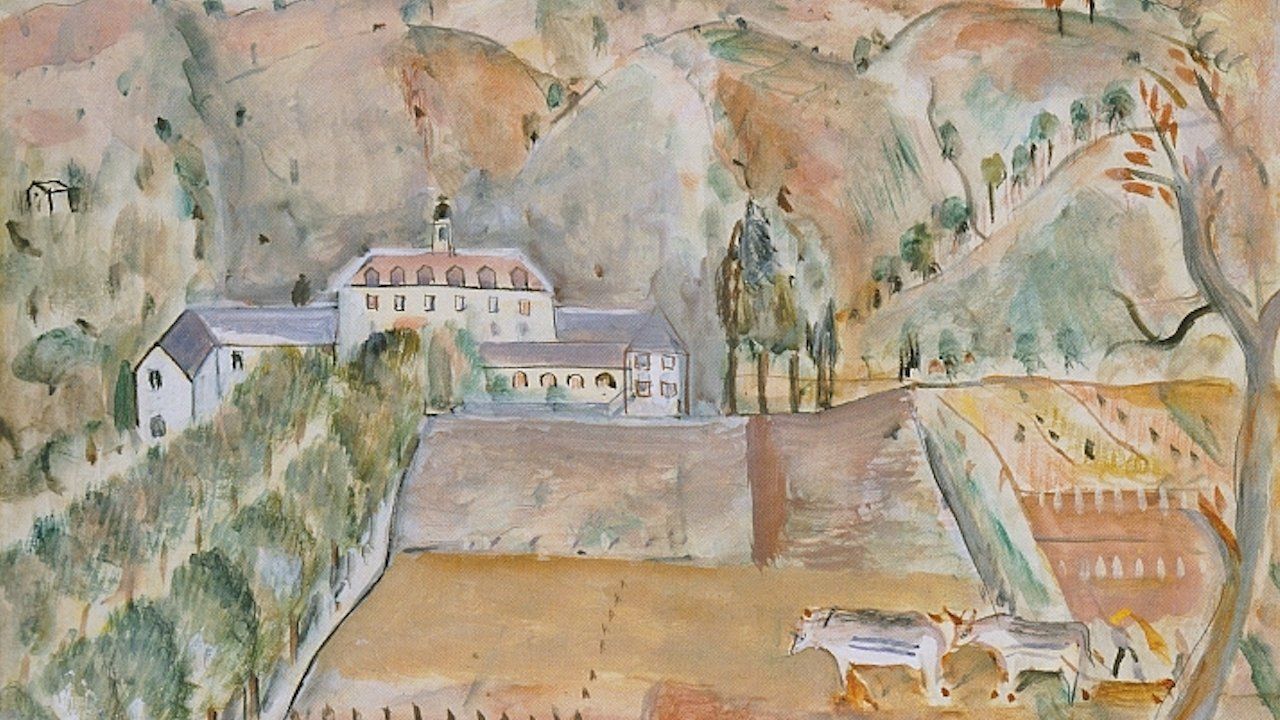
Roman Land by David Jones (1928)
She that loves place, time, demarcation, hearth, kin, enclosure, site, differentiated cult, though she is but one mother of us all: one earth brings us all forth, one womb receives us all, yet to each she is other, named of some name other…
…other sons, beyond hill, over strath, or never so neighboring by nigh field or near crannog up stream. what co-tidal line can plot if nigrin or flax-head marching their wattles be cognate or german of common totem?
Tellus of the myriad names answers to but one name: From this tump she answers Jac o’ the Tump only if he call Great-Jill-of-the-tump-that-bare-me, not if he cry by some new fangle moder of far gentes over the flud, fer-goddes name from anaphora of far folk wont woo her; she’s a rare one for locality. Or, gently she bends her head from far-height when tongue-strings chime the name she whispered on known-site, as between sister and brother at the time of beginnings … when the wrapped bands are cast and the worst mewling is over, after the weaning and before the august initiations, in the years of becoming.
When she and he ‘twixt door-stone and fire-stane prefigure and puppet on narrow floor-stone the world-masque on wide world-floor.
When she attentively changes her doll-shift, lets pretend with solemnity as rocking the womb-gift.
When he chivvies house-pet with his toy basta, makes believe the cat o’ the world falls to the pitiless bronze.
Man-travail and woman-war here we see enacted are.
When she and he beside the settle, he and she between the trestle-struts, mime and bitter dance to come.
Check by chin at the childer-crock where the quick tears drop and the quick laughter dries the tears, within the rim of the shared curd-cup each fore-reads the world-storm.
Till the spoil-sport gammers sigh:
Now come on now little children, come on now it’s past the hour. Sun’s to roost, brood’s in pent, dusk-star tops mound, lupa sniffs the lode-damps for stragglers late to byre.
Come now it’s time to come now for tarry awhile and slow
cot’s best for yeanlings
crib’s best for babes
here’s a rush to light you to bed
here’s a fleece to cover your head
against the world-storm
brother by sister
under one brethyn [cloth]
kith of the kin warmed at the one hearth-flame
(of the seed of far-gaffer? fair gammer’s wer-gifts?)
cribbed in garth that the garth-Jill wards.
Though she inclines with attention from far fair-height outside all boundaries, beyond the known and kindly nomenclatures, where all names are one name, where all stones of demarcation dance and interchange, troia the skipping mountains, nod recognitions.
As when on known-site ritual frolics keep bucolic interval at eves and divisions when they mark the inflexions of the year and conjugate with trope and turn the season’s syntax, with beating feet, with wands and pentagons to spell out the Trisagion.
Who laud and magnify with made, mutable and beggarly elements the unmade immutable begettings and precessions of fair-height, with halting sequences and unresolved rhythms, searchingly, with what’s to hand, under the inconstant lights that hover world-flats, that bright by fit and start the tangle of the world-wood, rifting the dark drifts for the wanderers that wind the world-meander, who seek hidden grammar to give back anathema its first benignity.
Gathering all things in, twining each bruised stem to the swaying trellis of the dance, the dance about the sawn lode-stake on the trellis of the dance, the dance about the sawn lode-stake on the hill where the hidden stillness is at the core of struggle, the dance around the green lode-tree on far fair-height where the secret guerdons hand and the bright prizes nod, where sits the queen im Rosenbage eating the honey-cake, where the king sits, counting-out his man-geld, rhyming the audits of all the world-holdings.
Where the marauder leaps the wall and the wall dances to the marauder’s leaping, where the plunging wolf-spear and the wolf’s pierced diaphragm sing the same song …
Yet, when she stoops to hear you children cry
from the scattered and single habitations
or from the nucleated holdings
from tower’d castra
paved civitas
treble-ramped caer [fort, castle, city]
or wattled tref [hamlet]
stockaded gorod or
trenched burb
from which ever child-crib within whatever enclosure
demarked by a dynast or staked by consent
wherever in which of the wide world-ridings
you must not call her but by that name
which accords to the morphology of that place.
Now pray now little children for us all now, pray our gammer’s
prayer according to our disciplina given to us
within our labyrinth on our dark mountain.
Say now little children
Sweet Jill of our hill hear us
bring slow bones safe at the lode-ford
keep lupa’s bite without our wattles
make her bark keep children good
save us all from dux of far folk
save us from the men who plan.
Now sleep on, little children, sleep on now, while I tell out the greater suffrages, not yet for young heads to understand:
Queen of the differentiated sites, administratix of the demarcations, let our cry come unto you.
In all times of imperium save us when the mercatores come save us
from the guile of the negotiatores save us from the missi, from the agents
who think no shame
by inquest to audit what is shameful to tell
deliver us.
When they check their capitularies in their curias
confuse their reckonings.
When they narrowly assess the trefydd [hamlets]
by hide and rod
by pentan [hob, fire-stone] and pent
by impost and fee on beast-head
and roof-tree
and number the souls of men
notch their tallies false
disorder what they have collated.
When they proscribe the diverse uses and impose the
rootless uniformities, pray for us.
When they sit in Consilium
to liquidate the holy diversities.
mother of particular perfections
queen of otherness
mistress of asymmetry
patroness of things counter, parti, pied, several
protectress of things known and handled
help of things familiar and small
wardress of the secret crevices
of things wrapped and hidden
mediatrix of all the deposits
margravine of the troia [meander, from troi, to turn, and Trea, Troy]
empress of the labyrinth
receive our prayers.
When they escheat to the Ram
in the Ram’s curia
the seisin where the naiad sings
above where the forked rod bends
or where the dark outcrop
tells on the hidden seam
pray for the green valley.
When they come with writs of oyer and terminer
to hear the false and
determine the evil
according to the advices of the Ram’s magnates who serve the Ram’s wife, who write in the Ram’s book of Death.
In the bland megalopolitan light
where no shadow is by day or by night
be our shadow.
Remember the mound-kin, the kith of the tarren [tump, knoll] gone from this mountain because of the exorbitance of the Ram … remember them in the rectangular tenements, in the houses of the engines that fabricate the ingenuities of the Ram … Mother of Flowers save them then where no flower blows.
Though they shall not come again because of the requirements of the Ram with respect to the world plan, remember them where the dead forms multiply, where no stamen leans, where the carried pollen falls to the adamant surfaces, where is no crevice.
In all times of Gleichschaltung, in the days of the central economies, set up the hedges of illusion round some remnant of us, twine the wattles of mist, white-web a Gwydion-hedge
like fog on the bryniau [hills]
against the commissioners
and assessors bearing the writs of the Ram to square the world-floor and number the tribes and write down the secret things and take away the diversities by which we are, by which we call on your name, sweet Jill of the demarcations
arc of differences
tower of individuation
queen of the minivers
laughing in the mantle of variety
belle of the mound
for Jac o’the mound
our belle and donnabelle
on all the world-mountain.
In the December of our culture ward somewhere the secret seed, under the mountain, under and between, between the grids of the Ram’s survey when he squares the world-circle.
Sweet Mair devise a mazy-guard
in and out and round about
double-dance defences
countermure and echelon meanders round
the holy mound
fence within the fence
pile the dun ash for the bright seed
(within the curtained wood the canister within the canister the budding rod)
troia in depth the shifting wattles of illusion for the ancilia for the palladia for the kept memorials, because of the commissioners of the Ram and the Ram’s decree concerning the utility of the hidden things.
When the technicians manipulate the dead limbs of our culture as though it yet had life, have mercy on us. Open unto us, let us enter a second time within your stola-folds in those days – ventricle and refuge both, bendref [ancestral dwelling, winter quarters] for world-winter, asylum from world-storm. Womb of the Lamb the spoiler of the Ram.
*From The Sleeping Lord and other fragments (London: Faber & Faber, 1974), pp. 59-64.
Share this Post on Your Preferred Platform