Orthodox Funeral Hymns

by St John of Damascus


Synaxis of the Twelve Holy Apostles

Anno Domini 2021, June 30
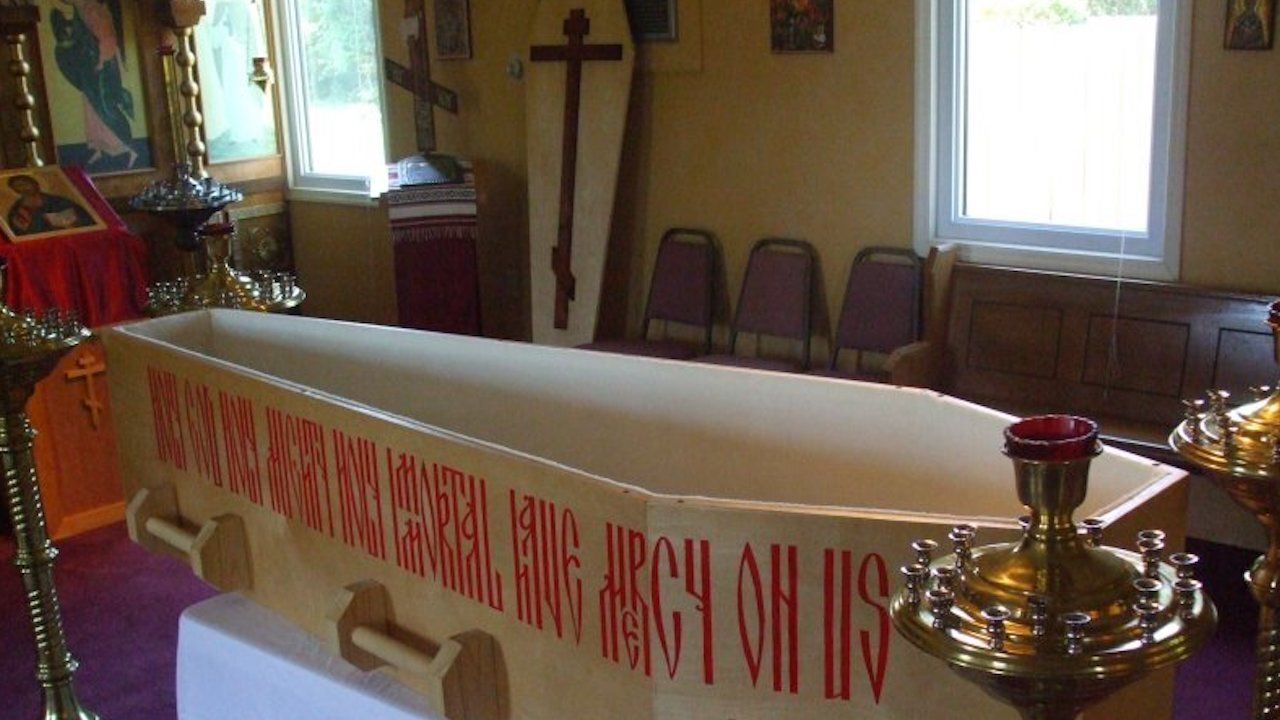
Tone 1: Where is the pleasure in life which is unmixed with sorrow? Where the glory which on earth has stood firm and unchanged? All things are weaker than shadow, all more illusive than dreams; comes one fell stroke, and Death in turn, prevails over all these vanities. Wherefore in the Light, O Christ, of Your countenance, the sweetness of Your beauty, to him (her) whom You have chosen grant repose, for You are the Friend of Mankind.


Tone 2: Like a blossom that wastes away, and like a dream that passes and is gone, so is every mortal into dust resolved; but again, when the trumpet sounds its call, as though at a quaking of the earth, all the dead shall arise and go forth to meet You, O Christ our God: on that day, O Lord, for him (her) whom You have withdrawn from among us appoint a place in the tents of Your Saints; yea, for the spirit of Your servant, O Christ.


Tone 2: Alas! What an agony the soul endures when from the body it is parting; how many are her tears for weeping, but there is none that will show compassion: unto the angels she turns with downcast eyes; useless are her supplications; and unto men she extends her imploring hands, but finds none to bring her rescue. Thus, my beloved brethren, let us all ponder well how brief is the span of our life; and peaceful rest for him (her) that now is gone, let us ask of Christ, and also His abundant mercy for our souls.


Tone 3: Vanity are all the works and quests of man, and they have no being after death has come; our wealth is with us no longer. How can our glory go with us? For when death has come all these things are vanished clean away. Wherefore to Christ the Immortal King let us cry, “To him (her) that has departed grant repose where a home is prepared for all those whose hearts You have filled with gladness.”


Tone 4: Terror truly past compare is by the mystery of death inspired; now the soul and the body part, disjoined by resistless might, and their concord is broken; and the bond of nature which made them live and grow as one, now by the edict of God is rest in twain. Wherefore now we implore Your aid grant that Your servant now gone to rest where the just that are Yours abide, Life-bestower and Friend of Mankind.


Tone 4: Where is now our affection for earthly things? Where is now the alluring pomp of transient questing? Where is now our gold, and our silver? Where is now the surging crowd of domestics, and their busy cries? All is dust, all is ashes, all is shadow. Wherefore draw near that we may cry to our immortal King, “Lord, Your everlasting blessings vouchsafe unto him (her) that now has gone away. bringing him (her) to repose in that blessedness which never grows old.”


Tone 5: I Called to mind the Prophet who shouted, “I am but earth and ash.” And once again I looked with attention on the tombs, and I saw the bones therein which of flesh were naked; and I said, “Which indeed is he that is king? Or which is soldier? Which is the wealthy, which the needy? Which the righteous, or which the sinner?” But to Your servant, O Lord, grant that with the righteous he (she) may repose.


Tone 6: My beginning and foundation was the form; bestowing Word of Your commandment; for it pleased You to make me by compounding visible and invisible nature into a living thing. Out of earth was my body formed and made, but a soul You gave me by the Divine and Life-creating in-breathing. Wherefore, O Christ, to Your servant in the land of the living, in the courts of the righteous, do You grant repose.


Tone 7: Bring to his (her) rest, O our Savior, You giver of life, our brother (sister) whom You have withdrawn from this transient world, for he (she) lifts up his (her) voice to cry: “Glory to You.”


Tone 7: When in Your own image and likeness You in the beginning did create and fashion man, You gave him a home in Paradise, and made him the chief of your creation. But by the devil’s envy, alas, beguiled to eat the fruit forbidden, transgressor then of Your commandments he became; wherefore back to earth, from which he first was taken, You did sentence him to return again, O Lord, and to pray You to give him rest.


Tone 8: Weep, and with tears lament when with understanding I think on death, and see how in the graves there sleeps the beauty which once for us was fashioned in the image of God, but now is shapeless, ignoble, and bare of all the graces. O how strange a thing; what is this mystery which concerns us humans? Why were we given up to decay? And why to death united in wedlock? Truly, as it is written, these things come to pass by ordinance of God, Who to him (her), now gone gives rest.


Glory to the Father and to the Son and to the Holy Spirit.


The death which You have endured, O Lord, is become the harbinger of deathlessness; if You had not been laid in Your tomb, then would not the gates of Paradise have been opened; wherefore to him (her), now gone from us give rest, for You are the Friend of Mankind.


Both now and ever and to the ages of ages. Amen.


Virgin chaste and holy, Gateway of the Word, Mother of our God, make supplication that his (her) soul find mercy.

Share this Post on Your Preferred Platform

By Luke Taylor Gilstrap July 31, 2026
"What is it that has ordered the things of heaven and those of earth, the things which move through the air and those which move in the water; nay, rather the things which proceeded them: heaven and earth and the natures of fire and water? What is it that combined and arranged them...set them into motion and put them on their unceasing and unhindered course?..But who is the architect of these things? Or did not he who made them also bring them into being? We shall certainly not attribute such power to spontaneity." On the Orthodox Faith, Chapter 3 This comes after St. John of Damascus sets out to delineate between the created and the uncreated, a fact which, while at the core of existence, seems for him to be, for this very reason, the simplest to believe. Everything but God is created and, thus, susceptible to change. This means people, but this also means demons, angels, the rest of the created order across the entire cosmos. Everything is vulnerable to unrest. Except for God. If you have ever tried to explain the Holy Trinity to a child for the first time, maybe you have felt as I have the weightier, inexpressible side of God's unchangeability: how do I possibly communicate this essential fact to the person in front of me? (This is usually when my faint stutter starts to pop up again.) I like that here, like St. Patrick reaching for a three-leaf clover, St. John brings us back to earth to better understand the cosmos. Fire and water are no less mysteries than heaven and earth. And yet here we are, cooking and washing, eating and drinking, filled and sustained on what we can neither fully explain nor claim to have created. Only God is unchanging. Vice versa, God is the only constant we need. Maybe the rest is better left unsaid. LUKE TAYLOR GILSTRAP is Vice President of the Board of Directors for Eighth Day Institute. His poems have appeared in Spiritus, Ekstasis (Christianity Today), and Relief Journal, among others. He lives happily in Wichita, Kansas with his wife and three sons.
By Luke Taylor Gilstrap July 24, 2026
"Now, one who would speak or hear about God should know beyond any doubt that in what concerns theology and the Incarnation not all things are inexpressible and not all are capable of expression, and neither are all things unknowable nor are they all knowable. That which can be known is one thing, whereas that which can be said is another, just as it is one thing to speak and another to know. Furthermore, many of those things about God which are not clearly perceived cannot be fittingly described, so that we are obliged to express in human terms things which transcend the human order. Thus, for example, in speaking about God we attribute to Him sleep, anger, indifference, hands and feet, and the like." On the Orthodox Faith, Chapter 2 When I was studying Fiction in graduate school, one of the first methods I learned to really situate the reader in the story you were about to tell them was disorientation; if you wanted to ground them in one story, first you had pull the rug out from under their feet. So it's fitting that in the beginning of St. John Damascene's On the Orthodox Faith, before rebuilding our foundation, he first puts us squarely in limbo, seesawing back and forth between certainty and uncertainty. To paraphrase, there is no doubt (certainty) that about God some things can be expressed...but not all things (uncertainty). Some things about God are truly knowable (certainty), but some are unknowable (uncertainty). Oh, and while we're speaking about God (certainty), let's admit there's a gap, too, between what we say and what we know (uncertainty). My favorite line in this spiraling excerpt, "...it is one thing to speak, and another to know," takes me back to the final lines in Wendell Berry's poem, "How to Be a Poet," which he wrote primarily as a reminder to himself: Accept what comes from silence. Make the best you can of it. Of the little words that come out of the silence, like prayers prayed back to the one who prays, make a poem that does not disturb the silence from which it came. Wherever your preferences fall on the cataphatic or apophatic spectrum of theology (whether you lean more toward what we can say about God or what we cannot), Berry's poem, I think, would nod along with St. John: before we say too much, let our words be preserved by the silence from which they came. I'm thinking of the silence, that filling, restorative quiet I feel when I step into a cathedral or in some of my favorite moments with my kids in the early hours. Even before praying, can we hear the One already praying in us? ​​​​​​​Let's start there. LUKE TAYLOR GILSTRAP is Vice President of the Board of Directors for Eighth Day Institute. His poems have appeared in Spiritus, Ekstasis (Christianity Today), and Relief Journal, among others. He lives happily in Wichita, Kansas with his wife and three sons.
By Mark C. Watney July 20, 2026
Late-Night Bookstores and Spiritual Reading
By Sarah Orner July 20, 2026
On St. Benedict and the Making of Vows
By Luke Taylor Gilstrap July 20, 2026
The Pursuit of Truth in the Age of AI
By Michael Simmon July 20, 2026
On the Theology of Raising Chickens
By Luke Taylor Gilstrap July 20, 2026
G.K. Chesterton and Raising Small Children
By Fr. Mark Lovett June 9, 2026
"Seal of the Fathers"
By Luke Taylor Gilstrap June 9, 2026
In Memory of Warren Farha, 1955-2026
By Jeremy Wagner May 15, 2026
An Ode to St. Brendan the Voyager
More Posts