Paschal Canon
by St John of Damascus
Synaxis of the Twelve Holy Apostles
Anno Domini 2022, June 30
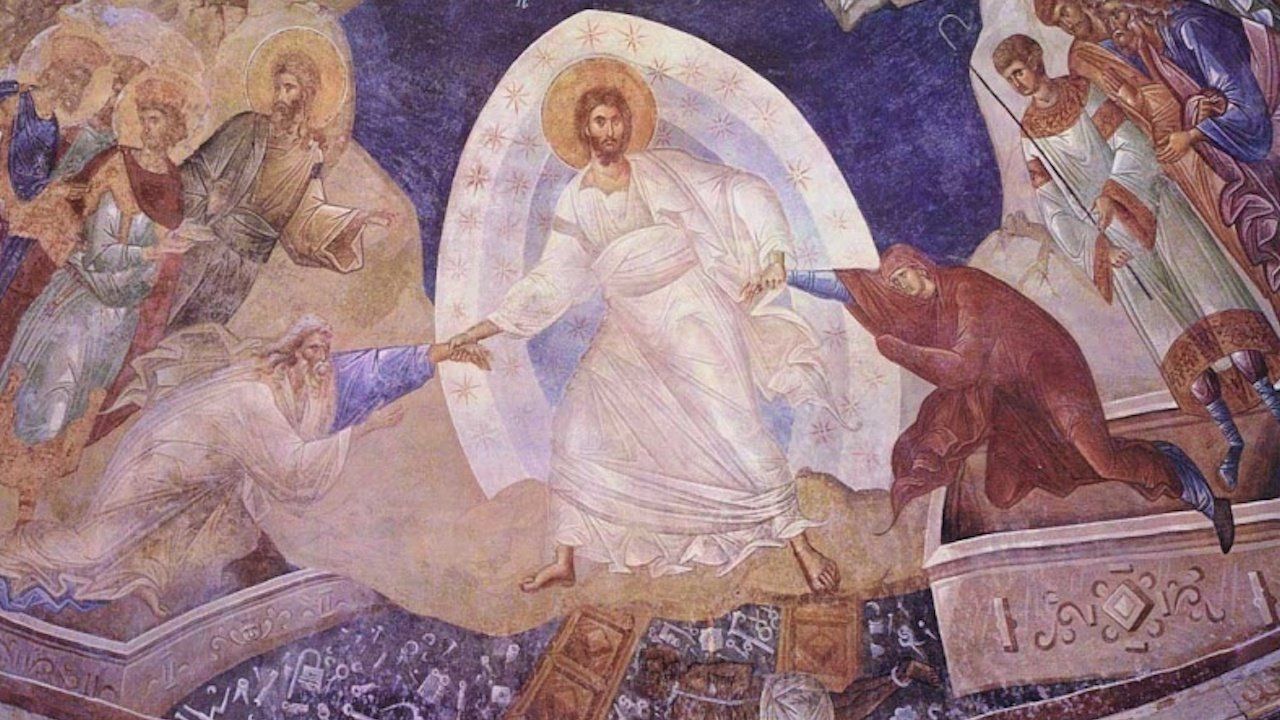
Ode 1: Song of Moses (Tone 1)
Irmos: The day of resurrection, let us be radiant, O peoples, Pascha, the Lord’s Pascha; for from death unto life, and from earth unto heaven, Christ our God has brought us over, as we sing the triumphant song.
Troparion 1: Let us purify our senses and then we shall see in the light unapproachable of the Resurrection Christ shining forth, and we shall clearly hear Him say “Rejoice!”, as we sing the triumphant song.
Troparion 2: Let the heavens, as is fitting, rejoice, and let the earth be glad; now let the universe entire, both seen and unseen, celebrate the feast; for Christ has risen, Christ our eternal joy.
Ode 3: Song of Anna
Irmos: Come, let us drink a new drink, not one wondrously brought forth from a barren rock, but incorruption’s source, which pours out from the sepulchre of Christ, in whom we are established.
Troparion 1: Now all things have been filled with light, both heaven and earth and all things beneath the earth; let all creation sing to celebrate the rising of Christ, by which it is established.
Troparion 2: Buried yesterday with you, O Christ, and today, as you arise, I am raised with you. I was crucified with you; O Saviour, grant me glory with you in your kingdom.
Ode 4: Prayer of Avvakum (Habakkuk)
Irmos: Now let the prophet Avvakum inspired by God keep godly watch as sentinel with us; let him point out an angel bearing blazing light, who with resounding voice declares, “Today is salvation for the world; for Christ has risen, as Omnipotent.”
Troparion 1: As a firstborn son, Christ appeared as a “male,” opening the virgin womb; as our food He is called “lamb”; as our Pascha free from stain unblemished He is named, and is designated, “perfect,” as He is true God
Troparion 2: As a. yearling lamb, blessed for us, the good crown, of His own free will and for all Christ our God was sacrificed, the Passover which purifies; from the tomb once again the fair Sun of Justice has shone for us.
Troparion 3: God’s forebear David dancing leaped before the sacred Ark; shadow was the Ark, but now seeing the fulfilment of the types, and full of God, let us God’s holy people rejoice; for Christ has risen as Omnipotent.
Ode 5: Prayer of Isaias
Irmos: Come let us arise in the early dawn, and instead of myrrh, the hymn of praise we shall offer to the Master; Christ Himself we then shall see, the risen Sun of Righteousness, who causes life to dawn for all.
Troparion 1: Seeing your measureless compassion, those who were straitly contrained by the bindings and cords of Hades, pressing forward to the light, O Christ, they. move with joyful steps, loudly they greet an eternal Pasch.
Troparion 2: Let us go out bearing torches, and meet Christ as He comes from the sepulchre like a Bridegroom; with the Angels’ festive ranks, together let us celebrate, feasting with them the saving Passion of God.
Ode 6: Prayer of Jonas
Irmos: You went down to the deepest parts of the earth, and the everlasting bars you shattered, which held imprisoned those fettered there; O Christ, on the third day, like Jonas from the whale, you arose from the sepulchre.
Troparion 1: Unbroken you preserved the seals, O Christ, in your rising from the tomb, nor injured the locks of the virgin womb in your birth, and have opened to us the portals of Paradise.
Troparion 2: My Saviour, living victim, and as God unsacrificed, yet to the Father willingly offering yourself, you raised with yourself all Adam’s race, in your rising from the sepulchre.
Ode 7: Prayer of the Three Holy Children
Irmos: He who of old freed the young men from the furnace, becoming human suffers as a mortal, and through suffering He clothes the mortal with the glory of incorruption, the only blessed and most glorious God of our fathers.
Troparion 1: With fragrant myrrh, godly minded women hastened after you; the One they sought with tears as mortal man they adored with joy as the Living God; good tidings they then proclaimed of the mystical Pasch to your disciples, O Christ.
Troparion 2: Now as a corpse death lies before us and we feast, Hell’s destruction, and the first-fruits of the new eternal life: as we leap for joy, we sing praises to the cause, the only blessed and most glorious God of our fathers.
Troparion 3: How truly holy and all festive this night of salvation, night yet full of light, the herald of the day of light, night the messenger which proclaims the Resurrection, in which the timeless light from the sepulchre shone bodily for all.
Ode 8: Song of the Three Holy Children
Irmos: This is the chosen and holy day, the first of all Sabbaths, it is the Queen and Lady, the Feast of Feasts, and the Festival it is of Festivals, on which we bless Christ to all the ages.
Troparion 1: Come, let us share the new fruit of the vine, of gladness divine, on this resplendent and refulgent day of the rising of Christ, on this day of the Kingdom of Christ our Lord, which praises we sing to Him as God to all the ages.
Troparion 2: Lift your eyes around you, O Sion, and see, for behold they have come like beacons blazing forth with light divine from the West and from the North, from the East and from the Sea, your children come to you, blessing Christ in you to all the ages.
Troparion 3: Father almighty, Word of God, and Spirit, nature united in trinity of persons, transcending being, and transcending Godhead, into you we have been baptized, and we bless you to all the ages.
Ode 9: Songs of the Mother of God and of Zacharias
Irmos: Enlightened, be enlightened, O New Jerusalem, for the glory of the Lord has risen upon you, dance now, O Sion, rejoice and be glad, you too rejoice, all pure Mother of God, as He arises, to whom you gave birth
Troparion 1: O divine! O beloved! O your sweetest voice! True the promises you made to us, to be with us evermore, even, O Christ, until time finds its end; this we possess as an anchor of hope, and we, the faithful, rejoice therein.
Troparion 2: O Pascha, great Pascha, great and most sacred Pascha, Christ! O Wisdom, O Word of God, and Power of God! Grant us, O Lord to partake of you yet more clearly in the day which has no evening, of your Kingdom.
*Translated by Fr Ephrem Lash, The Services for the Holy and Great Sunday of Pascha (Manchester: Saint Andrew’s Monastery, 2000), 5-16; slight modifications made by Fr. Andrew Louth in St. John Damascene: Tradition and Originality in Byzantine Theology (Oxford: Oxford University Press, 2002), 258-274.
Share this Post on Your Preferred Platform